Paris Recommended Course

Stone Kings and Quiet Courtyards

Stone Kings and Quiet Courtyards — Paris: Sainte-Chapelle → NotreDameCathedral → Centre Pompidou → Le Marais District → Place des Vosges.

⏱ Total Duration: 5h 36m 📍 5 Stops 🚶 Total Route Distance: 3.0 km
Follow Route on iOS App Follow Route on Android App
Stone Kings and Quiet Courtyards
Interactive Route Map

Course Route Map (5 Stops · 5h 36m)

Step-by-Step Route

Course Itinerary & Walking / Transit Directions

Tap any landmark to check full opening hours, admission fees, and nearby spots.

Sainte-Chapelle

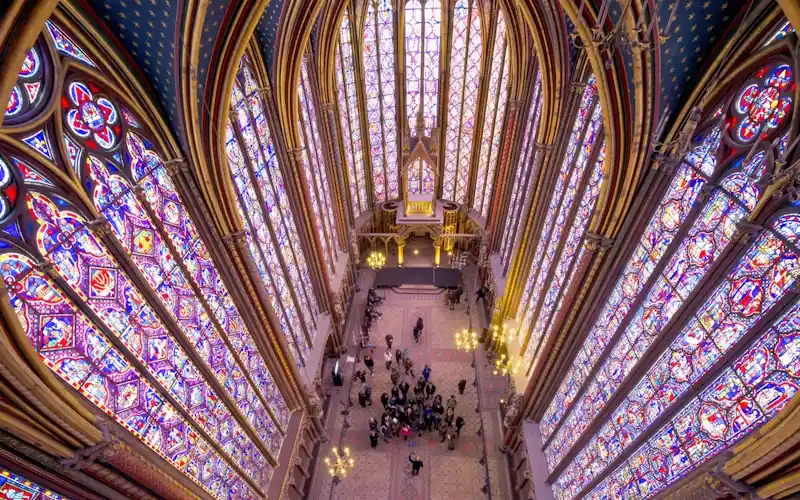
Sainte-Chapelle is a stunning Gothic chapel famous for its towering stained glass windows that fill the interior with vibrant colors and light, originally built to house religious relics, and it offers one of the most visually striking and intimate architectural experiences in Paris.

🕒 Typically 09:00–19:00 (seasonal variation) 🎟 https://www.sainte-chapelle.fr/en/visit/practical-information#rates Place Guide →
🚶 Walking 8 min · 592 m
NotreDameCathedral

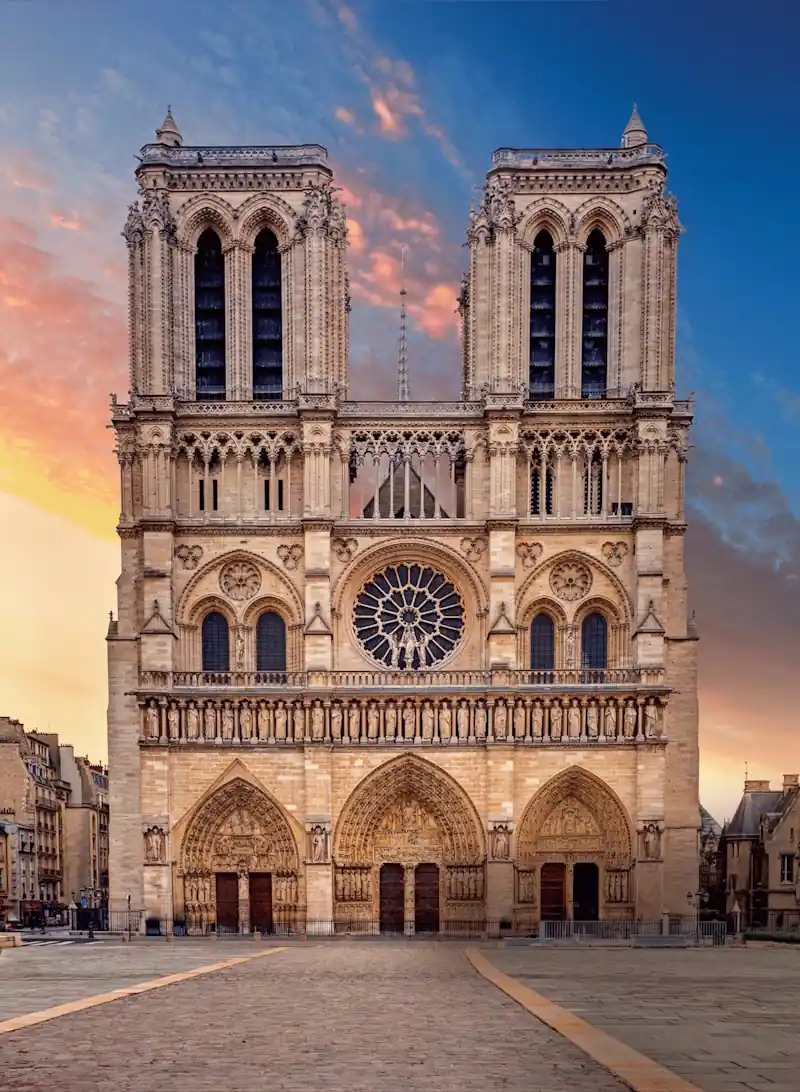
Notre-Dame Cathedral is one of the finest examples of French Gothic architecture, famous for its twin towers, intricate sculptures, and stunning stained glass windows, and it remains a symbol of Paris’s history, resilience, and cultural heritage despite the devastating fire in 2019.

🕒 Open daily 🎟 Free Place Guide →
🚶 Walking 14 min · 1.0 km
Centre Pompidou

Opened in 1977 and named for President Georges Pompidou, who championed the project, the Centre Pompidou startled Paris on arrival with its inside-out architecture: structural beams, escalators, and color-coded service pipes (blue for air, green for water, yellow for electricity, red for movement) run along the exterior rather than being hidden inside, a radical design by architects Renzo Piano and Richard Rogers that freed the interior into vast, column-free, endlessly reconfigurable exhibition floors. That interior houses the Musee National d'Art Moderne, one of the largest collections of 20th and 21st century art in the world, spanning Matisse, Picasso, Kandinsky, and generations of contemporary practice, alongside a major public library and a lively plaza out front that has long attracted street performers and skateboarders. The building's exposed escalator tube, climbing diagonally up the facade in a transparent glass caterpillar, doubles as an informal observation deck, offering one of the more surprising rooftop panoramas over the Right Bank rooftops toward Sacre-Coeur.

🕒 Open daily 🎟 Free Place Guide →
🚶 Walking 3 min · 219 m
🚇 29 (Centre Georges Pompidou → Place des Vosges) · 7 min (956 m)
🚶 Walking 2 min · 129 m
Le Marais District

Le Marais is one of the most vibrant and historically layered neighborhoods in Paris — a remarkably well-preserved medieval quarter on the Right Bank of the Seine whose narrow streets and magnificent Renaissance mansions (hotels particuliers) survived the great 19th-century modernization of Paris that demolished most of the medieval city, leaving the Marais as an irreplaceable repository of Paris's pre-Haussmann urban fabric. The district's history spans the full arc of Parisian life — it was the aristocratic heart of Paris during the 16th and 17th centuries, when the nobility built the elegant mansions that still line its streets and gathered around the Place des Vosges, the oldest planned square in Paris, built by Henri IV in 1612 and still one of the most beautiful urban spaces in France. The Jewish Quarter centered on the Rue des Rosiers has been a center of Parisian Jewish life since the 13th century, and despite the devastation of the Holocaust, it retains its character as a living Jewish neighborhood with synagogues, kosher restaurants, and bakeries that make it one of the most authentic Jewish quarters in Western Europe. Today the Marais is also celebrated as one of the most creative and fashionable neighborhoods in Paris — its galleries, concept stores, vintage shops, and cutting-edge restaurants draw visitors from across the city and around the world, while its significant LGBTQ+ community has made it the cultural center of gay Paris for decades. The Marais is home to some of Paris's finest museums including the Musee Carnavalet (the history of Paris), the Musee Picasso, and the Musee de la Chasse et de la Nature, all housed in magnificent historic mansions that are themselves as interesting as the collections within.

🕒 Open year-round 🎟 Free Place Guide →
🚶 Walking 1 min · 53 m
Place des Vosges

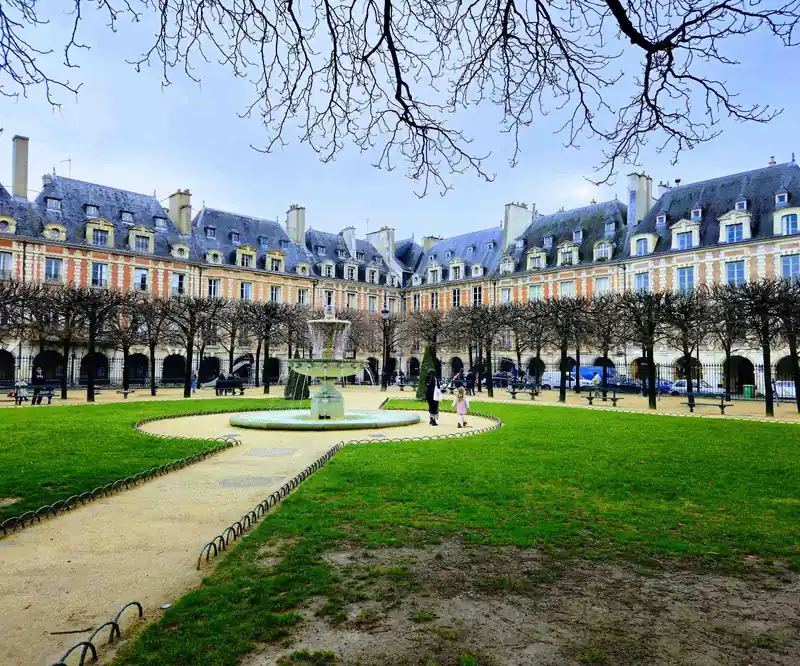
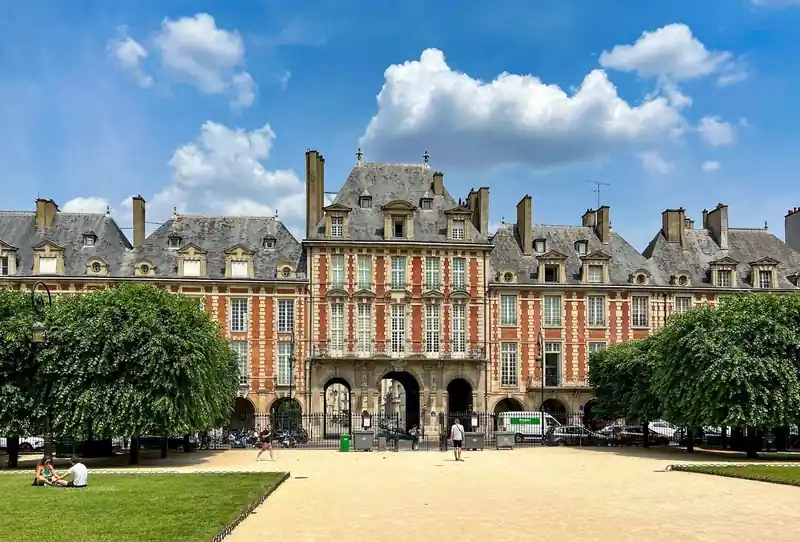
Built by King Henri IV in the early 17th century and completed in 1612, Place des Vosges is the oldest planned square in Paris, a perfect quadrangle of 36 nearly identical townhouses in red brick and pale stone joined by a continuous arcaded gallery at street level. It was originally called Place Royale and served as a fashionable address for nobility, a stage for royal celebrations, and even a dueling ground before it was renamed after the Vosges region during the Revolutionary era as a reward for the first department to pay its taxes in full. Victor Hugo lived at number 6 for sixteen years, and his apartment is now a small museum preserving period rooms and manuscripts. The central garden, with its clipped lime trees, fountains, and gravel paths, remains one of the quietest and most elegant public spaces in the Marais, a favorite spot for Parisians to read, picnic, or simply sit beneath the arcades away from the bustle of the surrounding streets.

🕒 Open 24 hours 🎟 Free Place Guide →
More Itineraries

Other Recommended Courses in Paris

Back to Paris Guide →

Plan & Navigate Your Trip with MyGuide

Explore 1,500+ cities, 10,000+ landmarks, step-by-step walking & transit itineraries, and chat with verified local tour hosts in 16 languages.