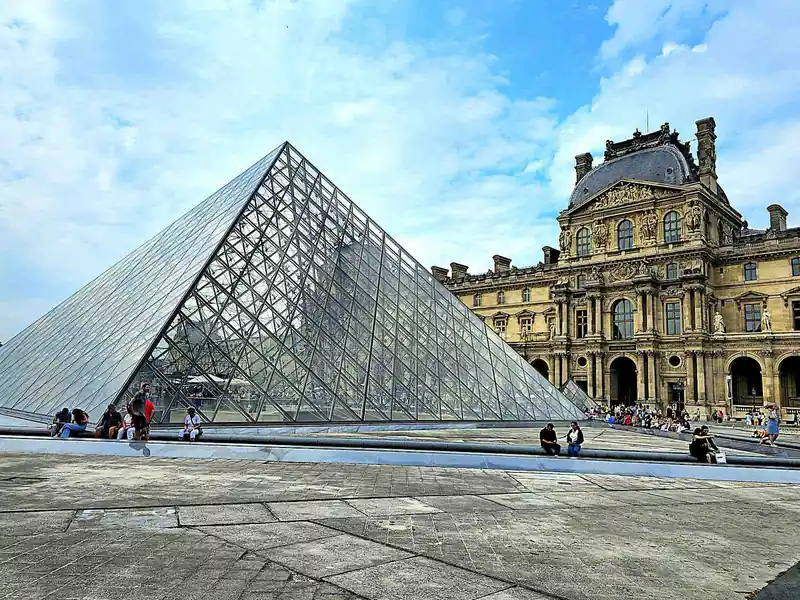
The Louvre Museum in Paris is the largest art museum in the world and one of the greatest cultural institutions in human history — a former royal palace whose vast galleries contain some 380,000 works of art spanning 8,000 years of human civilization, from prehistoric artifacts and ancient Egyptian masterpieces to the greatest paintings of the Renaissance, Baroque, and neoclassical periods, including Leonardo da Vinci's Mona Lisa, the Venus de Milo, and Winged Victory of Samothrace, making it the single most concentrated collection of cultural achievement anywhere on earth. The museum's history spans eight centuries — from its origins as a medieval fortress built by Philip II in the late 12th century, through its transformation into a royal palace under Francis I and subsequent centuries of expansion and embellishment, to its revolutionary-era conversion into a public museum in 1793, making it one of the first great public art museums in the world. The iconic glass pyramid designed by I.M. Pei, added to the main courtyard in 1989, caused controversy when it was built but is now beloved as the principal entrance to the museum and as a symbol of the productive dialogue between ancient history and modern architecture that defines the Louvre's character as an institution. The Mona Lisa, Leonardo da Vinci's small panel painting of an unidentified Florentine noblewoman, is the most visited work of art in the world — a crowd of hundreds gathers around it at any hour of the museum's operation, drawn by a combination of genuine artistic quality, centuries of scholarly attention, and the irresistible pull of its reputation as the most famous painting ever made. With over 9 million visitors annually, the Louvre is the most visited museum in the world.