Palais-Royal Garden
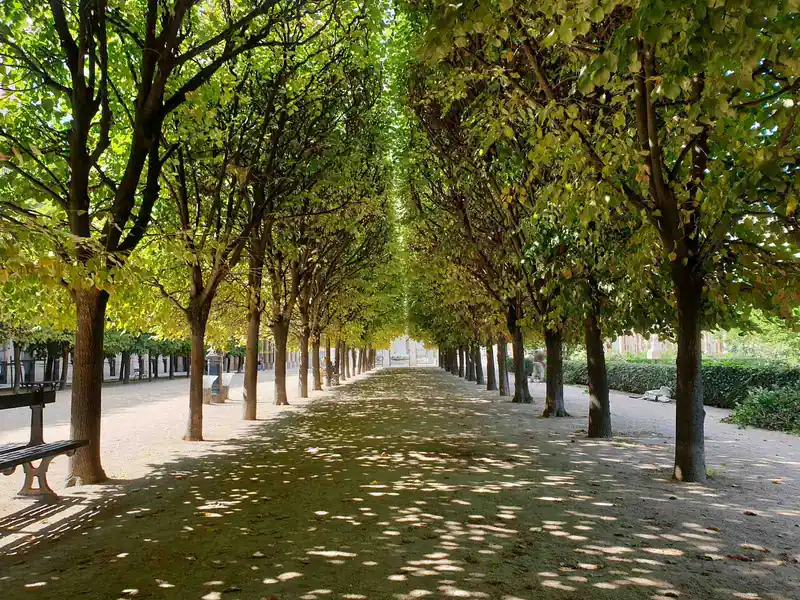
Tucked directly behind the Louvre and laid out in the 17th century for Cardinal Richelieu before passing to the royal family, the Palais-Royal Garden is a rectangular formal garden enclosed on three sides by uniform arcaded galleries that once housed some of Paris's most fashionable shops, gambling dens, and cafes, making the complex a center of Parisian social and political life in the 18th century, including gatherings in its cafes that helped spark the storming of the Bastille in 1789. Today the arcades hold a quieter mix of antique dealers, perfumers, and small boutiques, while the garden itself, lined with clipped lime trees, a central fountain, and rose beds, offers one of the most sheltered and peaceful green spaces in central Paris, largely unknown to visitors who pass right by its unassuming entrances. At the courtyard nearest the Comedie-Francaise, the sculptor Daniel Buren's 1986 installation of black-and-white striped columns of varying heights, known as Les Deux Plateaux, remains a favorite spot for children to climb and photographers to frame, a piece of contemporary public art set against 17th-century stone.
Visitor Information & Practical Details
- Place NamePalais-Royal Garden
- Address8 Rue de Montpensier, 75001 Paris, France
- Opening HoursOpen daily (check locally)
- Admission / PriceFree
- PhoneNot listed
- Official Websitehttps://en.wikipedia.org/wiki/Palais-Royal
- GPS Coordinates48.86497, 2.33781
Best Itinerary Visiting Palais-Royal Garden
Combine Palais-Royal Garden with nearby landmarks using our step-by-step walking and transit route.
Places Near Palais-Royal Garden
Build your own custom walking route in the MyGuide app by combining these nearby stops.
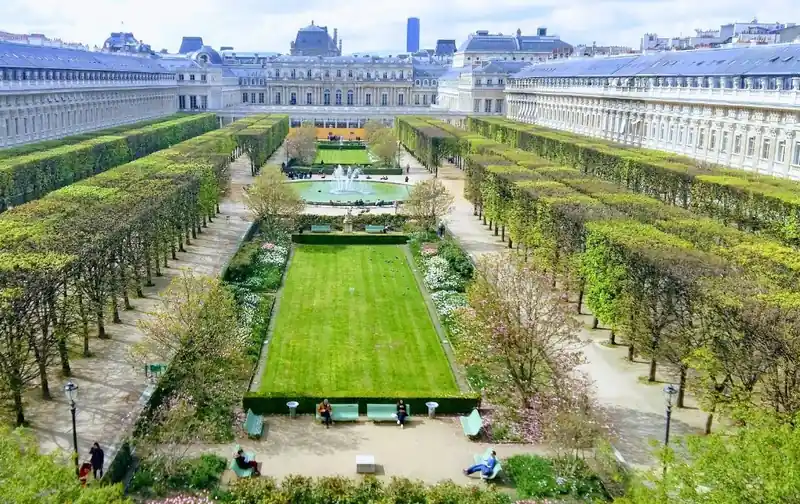
Palais-Royal Garden
Palais-Royal Garden is a refined and elegant courtyard garden in central Paris, known for its symmetrical layout, peaceful atmosphere, and the iconic black-and-white striped columns of the Colonnes de Buren, offering a quiet and artistic escape just steps away from the busy city streets.
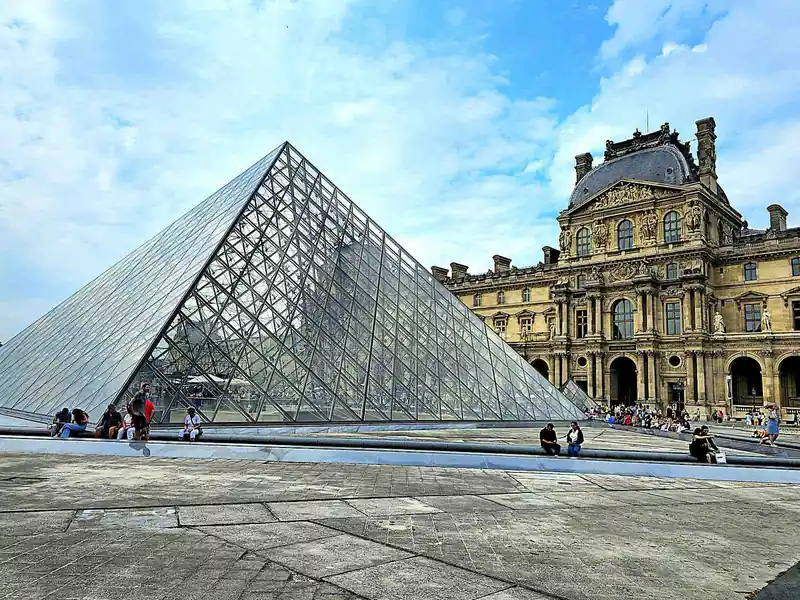
Louvre Museum
The Louvre Museum in Paris is the largest art museum in the world and one of the greatest cultural institutions in human history — a former royal palace whose vast galleries contain some 380,000 works of art spanning 8,000 years of human civilization, from prehistoric artifacts and ancient Egyptian masterpieces to the greatest paintings of the Renaissance, Baroque, and neoclassical periods, including Leonardo da Vinci's Mona Lisa, the Venus de Milo, and Winged Victory of Samothrace, making it the single most concentrated collection of cultural achievement anywhere on earth. The museum's history spans eight centuries — from its origins as a medieval fortress built by Philip II in the late 12th century, through its transformation into a royal palace under Francis I and subsequent centuries of expansion and embellishment, to its revolutionary-era conversion into a public museum in 1793, making it one of the first great public art museums in the world. The iconic glass pyramid designed by I.M. Pei, added to the main courtyard in 1989, caused controversy when it was built but is now beloved as the principal entrance to the museum and as a symbol of the productive dialogue between ancient history and modern architecture that defines the Louvre's character as an institution. The Mona Lisa, Leonardo da Vinci's small panel painting of an unidentified Florentine noblewoman, is the most visited work of art in the world — a crowd of hundreds gathers around it at any hour of the museum's operation, drawn by a combination of genuine artistic quality, centuries of scholarly attention, and the irresistible pull of its reputation as the most famous painting ever made. With over 9 million visitors annually, the Louvre is the most visited museum in the world.
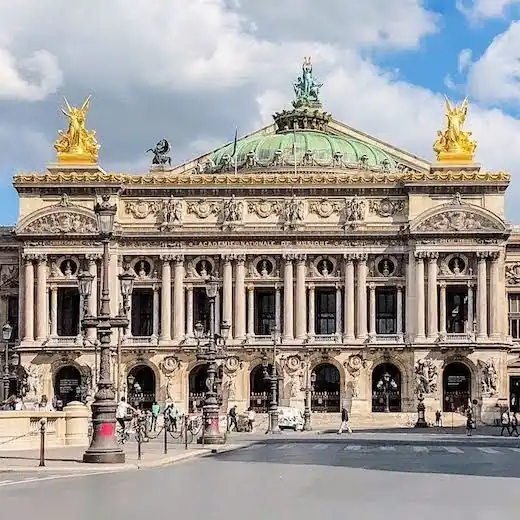
Opera Garnier
The Opera Garnier (Palais Garnier) is the most opulent theatre building in the world and the supreme achievement of Second Empire architecture — a magnificent palace of the arts built between 1861 and 1875 by the architect Charles Garnier whose Grand Staircase, Grand Foyer, auditorium, and facade represent the highest expression of 19th-century French decorative arts, combining marble, gilded bronze, painted ceilings, crystal chandeliers, and elaborately carved stone in an interior of such concentrated luxury that even in an era of extravagant public buildings it was recognized as something extraordinary. The opera was commissioned by Napoleon III as part of Baron Haussmann's comprehensive rebuilding of Paris, and Garnier won the competition for its design at the age of 35 with a proposal that rejected the severe neoclassicism of his competitors in favor of an eclectic synthesis of styles that Garnier called Napoleon III style — a combination of Baroque exuberance, Renaissance grandeur, and 19th-century theatrical fantasy that proved immediately controversial and enduringly beloved. The Grand Staircase is perhaps the most famous single room in any theatre building in the world — a double staircase rising through a space of marble columns, gilded balustrades, and painted ceilings where the audience itself becomes part of the spectacle as they ascend to their boxes, the whole arrangement conceived by Garnier as a theatre in which the social rituals of the opera-going public would be performed as conspicuously as the performances on stage. The building is perhaps most famous internationally through Gaston Leroux's 1910 novel The Phantom of the Opera, which used its underground lake, labyrinthine backstage passages, and Gothic atmosphere as the setting for one of the most enduringly popular romantic horror stories in literature.
Musee d'Orsay
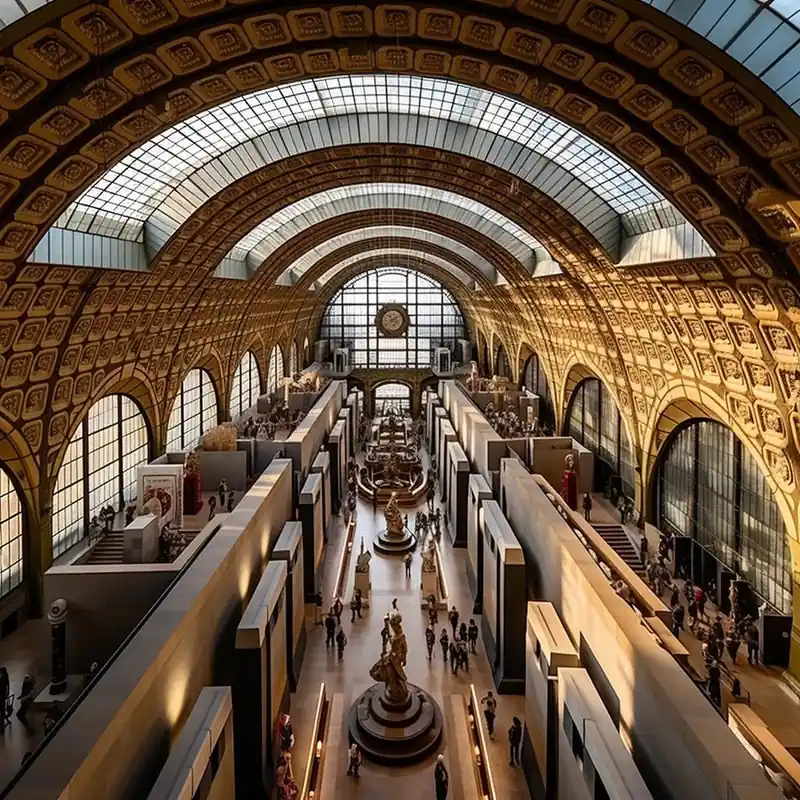
The Musee d'Orsay in Paris is the greatest collection of Impressionist and Post-Impressionist art in the world — a magnificent museum housed in a converted Beaux-Arts railway station on the banks of the Seine whose soaring glass roof, ornate ironwork, and monumental spaces provide a spectacular setting for the greatest concentration of works by Monet, Renoir, Degas, Pissarro, Sisley, Manet, Van Gogh, Gauguin, Cezanne, Seurat, and their contemporaries that can be found anywhere on earth. The museum occupies the former Gare d'Orsay, built for the 1900 Paris Universal Exhibition, whose operational life as a railway station ended in 1939 and which fell into disrepair until its conversion into a museum in 1986 — the transformation is one of the most successful museum conversions in history, with the station's original architecture preserved and celebrated while the spaces have been reorganized to create a series of galleries that move visitors through the development of Western art from 1848 to 1914. The Impressionist collection on the top floor — natural light flooding through the glass roof, the works arranged to show the development of the movement from its origins in Barbizon painting through its flowering in the canvases of the 1870s and 1880s to the Post-Impressionist explorations of Cezanne and Van Gogh — is one of the most extraordinary sequences of gallery rooms in any museum in the world, a sustained encounter with the greatest period of innovation in the history of Western painting. Among its greatest individual works are Manet's Olympia and Dejeuner sur l'herbe, Van Gogh's Self-Portrait, Whistler's Arrangement in Grey and Black No. 1 (Whistler's Mother), and Renoir's Dance at Le Moulin de la Galette.
Galeries Lafayette Haussmann
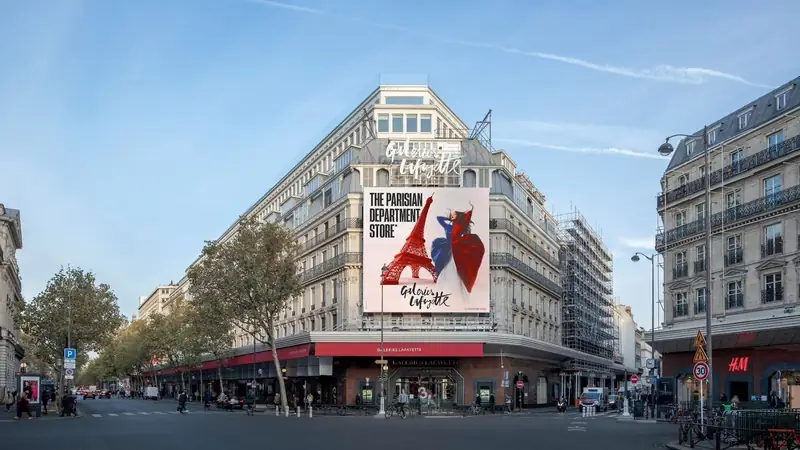
Founded in 1893 as a small haberdashery shop and expanded into its current flagship location beside the Opera Garnier in the early 20th century, Galeries Lafayette Haussmann is one of the most architecturally striking department stores in the world, built around a soaring Belle Epoque atrium topped by a stained-glass dome roughly 43 meters overhead, installed in 1912 in an Art Nouveau style of swirling ironwork and colored glass that remains the store's centerpiece regardless of the fashions sold beneath it. Spread across multiple connected buildings and floors devoted to womenswear, menswear, gourmet food, and luxury brands, the store has functioned since its founding as a showcase for French fashion and craftsmanship as much as a retail destination, and its window displays at Christmas remain a Parisian tradition drawing crowds regardless of whether they intend to shop. A free rooftop terrace, accessible without any purchase required, offers one of the more unexpected panoramic views in central Paris, looking directly across at the gilded dome of the Opera Garnier and out toward the rooftops of the surrounding grand boulevards.
Centre Pompidou
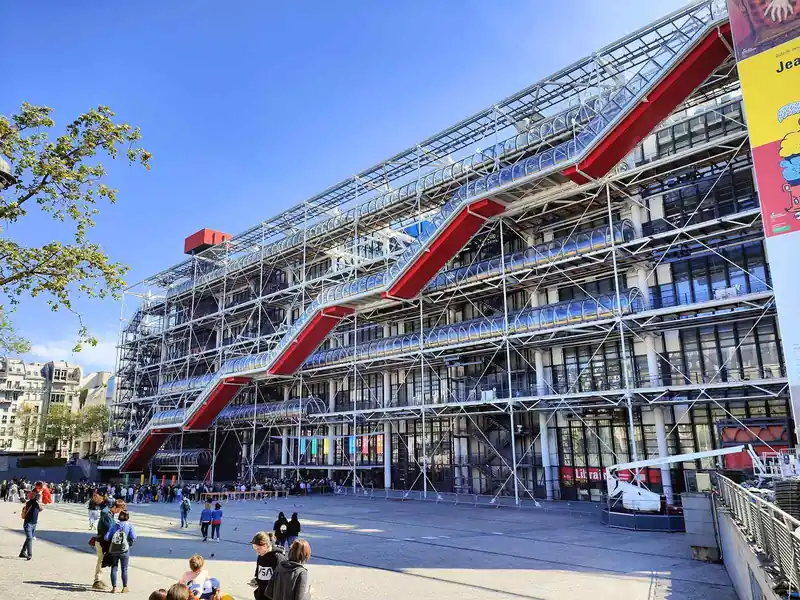
Opened in 1977 and named for President Georges Pompidou, who championed the project, the Centre Pompidou startled Paris on arrival with its inside-out architecture: structural beams, escalators, and color-coded service pipes (blue for air, green for water, yellow for electricity, red for movement) run along the exterior rather than being hidden inside, a radical design by architects Renzo Piano and Richard Rogers that freed the interior into vast, column-free, endlessly reconfigurable exhibition floors. That interior houses the Musee National d'Art Moderne, one of the largest collections of 20th and 21st century art in the world, spanning Matisse, Picasso, Kandinsky, and generations of contemporary practice, alongside a major public library and a lively plaza out front that has long attracted street performers and skateboarders. The building's exposed escalator tube, climbing diagonally up the facade in a transparent glass caterpillar, doubles as an informal observation deck, offering one of the more surprising rooftop panoramas over the Right Bank rooftops toward Sacre-Coeur.
