Chatuchak Weekend Market (also “JJ Market”)
A Market Born from a Government Policy to Consolidate Bangkok's Scattered Vendors -- Chatuchak Weekend Market traces its origin to 1942, when the Thai government under Prime Minister Plaek Phibunsongkhram ordered that every province hold a weekly market, intending to organize the informal vendors scattered across Bangkok's streets rather than let them operate independently. Over the following decades, these consolidated markets gradually moved and merged until settling at the current Chatuchak location in the 1980s, growing into one of the largest weekend markets in the world, with an estimated 15,000 stalls packed into a grid of numbered sections covering everything from antiques to live animals. What began as a bureaucratic effort to bring order to street vending became one of the most disorienting, maze-like shopping experiences in Southeast Asia.
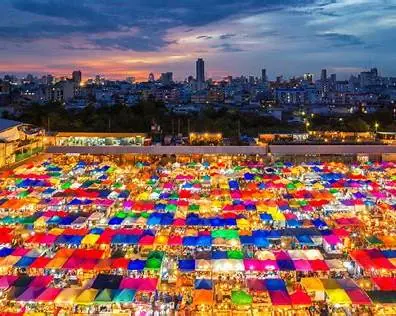
Visitor Information & Practical Details
- Place NameChatuchak Weekend Market (also “JJ Market”)
- Address587/10 Kamphaeng Phet 2 Rd, Chatuchak, Bangkok 10900, Thailand
- Opening HoursTypically open Saturday and Sunday ~09:00–18:00 (some Friday evening sections too)
- Admission / PriceFree (no ticket required)
- PhoneNot listed
- Official Websitehttps://www.chatuchakmarket.org
- GPS Coordinates13.80083, 100.55139
Best Itinerary Visiting Chatuchak Weekend Market (also “JJ Market”)
Combine Chatuchak Weekend Market (also “JJ Market”) with nearby landmarks using our step-by-step walking and transit route.
Places Near Chatuchak Weekend Market (also “JJ Market”)
Build your own custom walking route in the MyGuide app by combining these nearby stops.
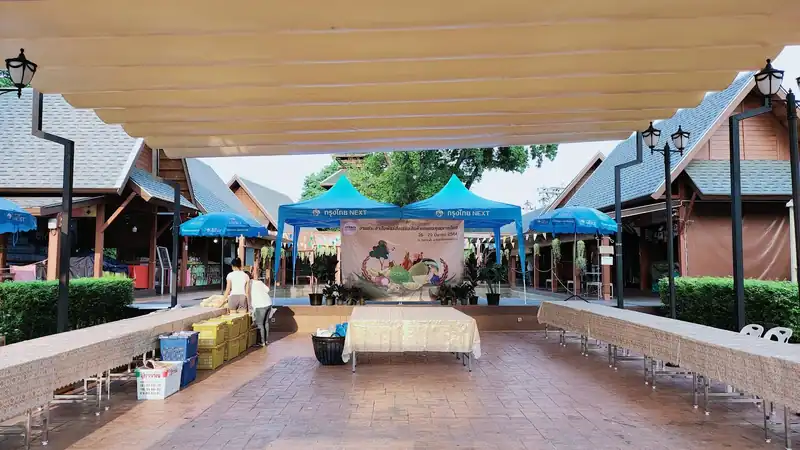
Or Tor Kor Market
One of the World's Best Food Markets, Overlooked Because It Sits Across the Street From a More Famous One -- Or Tor Kor Market has repeatedly been named among the best fresh food markets on the planet by international food publications, praised for its immaculately clean stalls, pristine seafood displays, and some of the highest-quality Thai produce, ready-to-eat dishes, and tropical fruit available anywhere in Bangkok, favored by professional chefs and serious home cooks over flashier tourist markets. Yet it sits almost literally across the street from Chatuchak Weekend Market, one of the largest and most visited markets in the world, whose sheer scale and reputation pulls the overwhelming majority of tourist foot traffic, leaving Or Tor Kor as the market locals quietly prefer while visitors crowd into its far more chaotic neighbor across the road. The two markets function almost like inverse images of each other within sight of one another, one world-famous and touristy, the other critically acclaimed and comparatively empty of tourists, separated by nothing more than a single street.
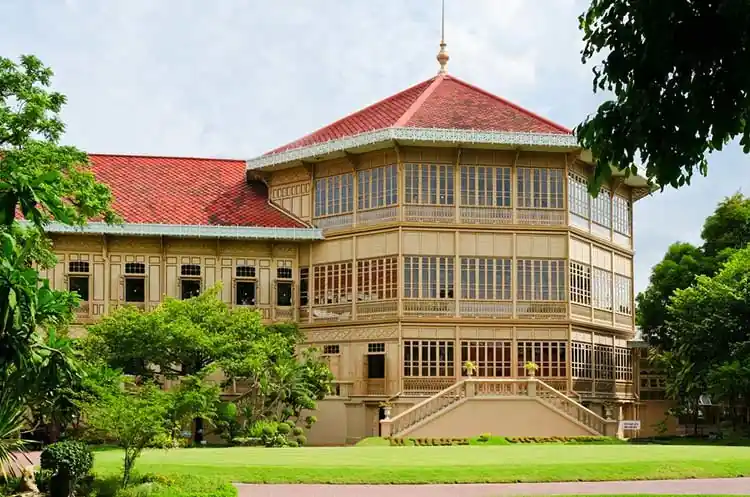
Vimanmek Mansion
The World's Largest Golden Teak Building, Assembled Without a Single Nail, and Also a Royal Residence that Once Floated Down a River -- Vimanmek Mansion was built in 1901 for King Rama V entirely out of golden teak wood, making it the largest teak building on Earth, and its construction relies not on a single nail but on traditional wooden joinery, with pegged and interlocking joints holding together three stories and dozens of rooms. The building itself has a history of movement rather than permanence, originally constructed on Koh Si Chang island, then entirely dismantled piece by piece, floated up the Chao Phraya River by barge, and reassembled on its current site in Dusit, meaning this royal residence physically migrated across Thailand before it ever hosted a single resident. King Rama V reportedly used it as his primary residence for several years while overseeing the construction of nearby Dusit Palace, before moving on, leaving behind a building that is simultaneously a carpentry marvel, a piece of relocated architecture, and today a museum of royal history.
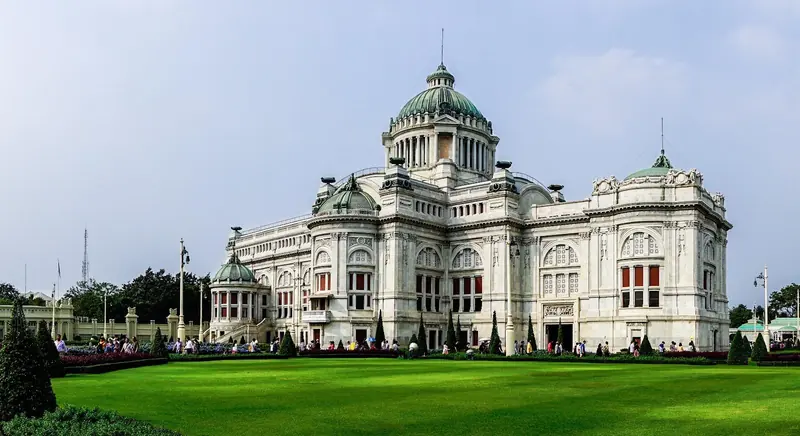
Ananta Samakhom Throne Hall
A Thai Royal Throne Hall Deliberately Built to Look Western, as a Defense Against Colonization -- Ananta Samakhom Throne Hall was commissioned by King Rama V and completed in 1915, an Italian Renaissance-style domed marble hall built using imported Carrara marble and designed by Italian architects, a building that looks, at first glance, as though it could stand in Rome or Vienna rather than Bangkok. The choice was deliberate and strategic rather than purely aesthetic: built during an era when Britain and France were actively carving up Southeast Asia into colonies, Rama V and his successors used European-style architecture, European-educated advisors, and a modernized government apparatus to present Siam as already civilized and modern by Western standards, making the kingdom harder to justify colonizing. The strategy worked, at least in part, since Thailand remains the only country in Southeast Asia never formally colonized by a European power, meaning this marble hall, built to resemble someone else's monarchy, stands today as physical evidence of a deliberate political performance that helped keep the kingdom independent.
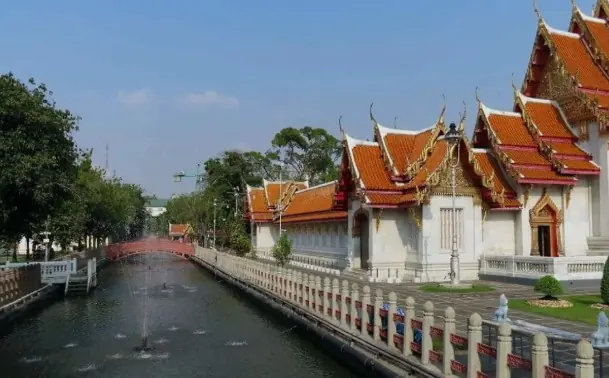
Wat Benchamabophit (The Marble Temple)
The Only Major Bangkok Temple Built from Italian Marble -- Wat Benchamabophit was commissioned by King Rama V in the late 19th century after his tours of Europe, and he deliberately broke with tradition by having the entire ordination hall clad in white Carrara marble imported from Italy rather than the plastered brick typical of Thai temple construction, earning it the common name the Marble Temple. The building layers European engineering onto a Thai temple form: its windows are fitted with stained glass depicting scenes from Buddhist cosmology rather than Christian iconography, and its courtyard gallery houses over fifty Buddha images cast or copied from historic originals across Thailand, assembled as a kind of study collection of regional styles. The temple remains closely tied to the royal family, serving as the site of royal cremations and ceremonies.
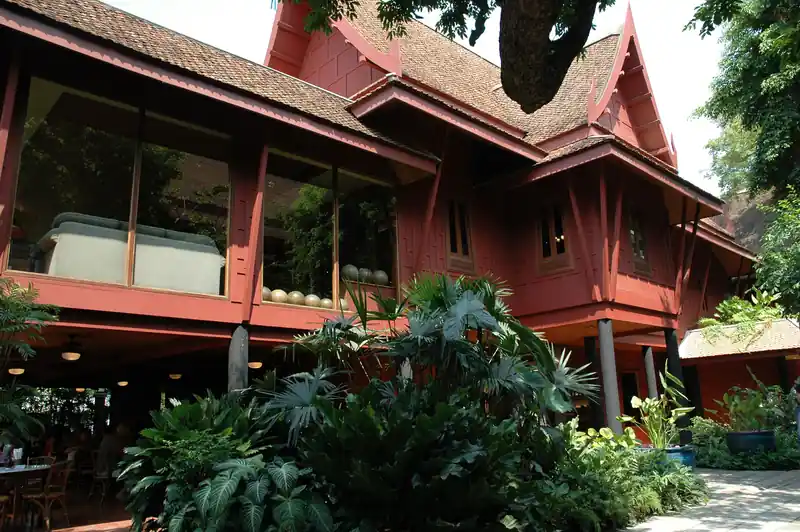
Jim Thompson House
A Silk Revivalist's Home, Built from Six Relocated Teak Houses, Ending in an Unsolved Disappearance -- Jim Thompson was an American architect and former wartime intelligence officer who settled in Bangkok after World War II and is credited with reviving Thailand's declining silk-weaving industry into an internationally recognized export. His house, completed in 1959, was not built new but assembled from six traditional teak houses bought from different parts of central Thailand and reconstructed on this site, reversing the usual orientation of Thai houses so the best rooms faced the klong canal rather than the street. In 1967, Thompson vanished without a trace while walking in Malaysia's Cameron Highlands; no body, evidence, or confirmed explanation was ever found, and the disappearance remains officially unsolved, adding a layer of mystery to the collection of Southeast Asian art he left behind.
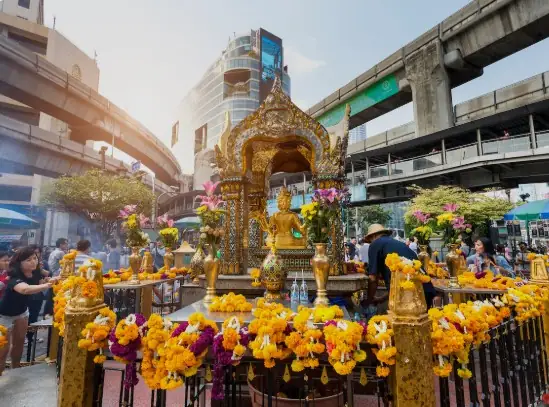
Erawan Shrine
A Shrine Built to Appease Bad Luck, Now Known for Hired Dancers and a 2015 Bombing -- The Erawan Shrine, dedicated to the four-faced Hindu creator god Brahma, known in Thai as Phra Phrom, was erected in 1956 after a string of construction accidents and worker injuries during the building of the adjacent Erawan Hotel; astrologers attributed the mishaps to bad spiritual timing in the hotel's foundation, and the shrine was installed to correct it, after which the construction problems reportedly stopped. The shrine became known for visitors who, upon having a wish granted, hire classical Thai dancers to perform at the site as a form of thanks, a transactional ritual now continuously staged throughout the day. In 2015 a bomb exploded at the shrine, killing more than twenty people in an attack whose motive and perpetrators were never definitively established, after which the shrine was repaired and reopened within weeks.
