Jim Thompson House
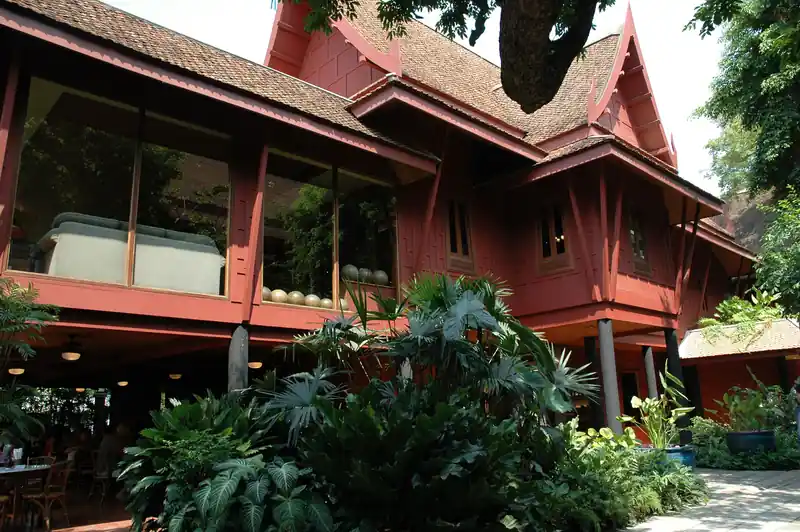
A Silk Revivalist's Home, Built from Six Relocated Teak Houses, Ending in an Unsolved Disappearance -- Jim Thompson was an American architect and former wartime intelligence officer who settled in Bangkok after World War II and is credited with reviving Thailand's declining silk-weaving industry into an internationally recognized export. His house, completed in 1959, was not built new but assembled from six traditional teak houses bought from different parts of central Thailand and reconstructed on this site, reversing the usual orientation of Thai houses so the best rooms faced the klong canal rather than the street. In 1967, Thompson vanished without a trace while walking in Malaysia's Cameron Highlands; no body, evidence, or confirmed explanation was ever found, and the disappearance remains officially unsolved, adding a layer of mystery to the collection of Southeast Asian art he left behind.
Visitor Information & Practical Details
- Place NameJim Thompson House
- Address6 Soi Kasemsan 2, Rama 1 Road, Bangkok 10330, Thailand
- Opening Hours10:00 – 17:00
- Admission / Price200 THB
- Phone+66 2 216 7368
- Official Websitehttps://www.jimthompsonhouse.org
- GPS Coordinates13.74930, 100.52850
Best Itinerary Visiting Jim Thompson House
Combine Jim Thompson House with nearby landmarks using our step-by-step walking and transit route.
Places Near Jim Thompson House
Build your own custom walking route in the MyGuide app by combining these nearby stops.
Bangkok Art and Culture Centre (BACC)
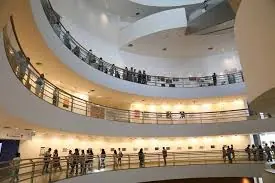
A Museum that Exists Because Activists Fought a Mall for the Land -- The Bangkok Art and Culture Centre occupies a site at the Pathumwan intersection, directly across from Siam Discovery and MBK Center, that for years was earmarked for yet another shopping mall before a sustained public campaign by artists and civic groups pushed the Bangkok Metropolitan Administration to instead build a contemporary art space on the land. The center finally opened in 2008 after roughly a decade of advocacy, delay, and political wrangling over its funding and purpose. Its building wraps nine floors around a central spiral atrium, a layout explicitly designed to reference the ramp of the Guggenheim Museum in New York, and it operates independently of government art institutions, giving it more latitude to show contemporary and sometimes politically pointed Thai work than state-run museums.
Asok Skywalk
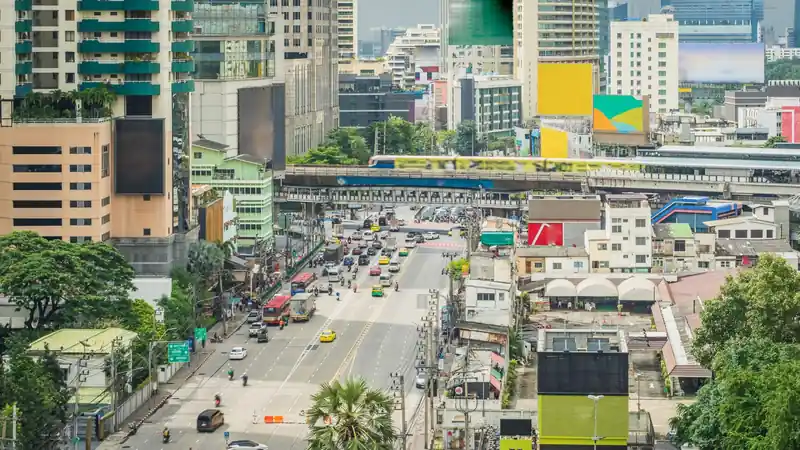
A Walkway Built to Tame Bangkok's Most Congested Intersection -- Asok Skywalk is a segment of Bangkok's growing network of elevated pedestrian walkways, built to connect the Asok BTS Skytrain station directly with the Sukhumvit MRT subway interchange across the street without forcing pedestrians to cross at ground level through one of the city's most notoriously congested intersections. The walkway forms part of a broader strategy, repeated at several other BTS-MRT interchange points across Bangkok, to stitch together the city's elevated rail and underground systems with covered, air-conditioned pedestrian bridges that bypass street-level traffic entirely. For a city built around canals long before cars and still struggling with some of Southeast Asia's worst traffic, these skywalks function as a kind of second, elevated street grid layered above the first, letting commuters move between transit lines, office towers, and shopping centers almost without ever touching the pavement below.
Erawan Shrine
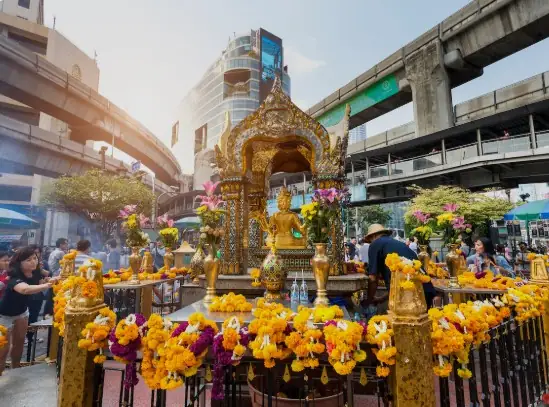
A Shrine Built to Appease Bad Luck, Now Known for Hired Dancers and a 2015 Bombing -- The Erawan Shrine, dedicated to the four-faced Hindu creator god Brahma, known in Thai as Phra Phrom, was erected in 1956 after a string of construction accidents and worker injuries during the building of the adjacent Erawan Hotel; astrologers attributed the mishaps to bad spiritual timing in the hotel's foundation, and the shrine was installed to correct it, after which the construction problems reportedly stopped. The shrine became known for visitors who, upon having a wish granted, hire classical Thai dancers to perform at the site as a form of thanks, a transactional ritual now continuously staged throughout the day. In 2015 a bomb exploded at the shrine, killing more than twenty people in an attack whose motive and perpetrators were never definitively established, after which the shrine was repaired and reopened within weeks.
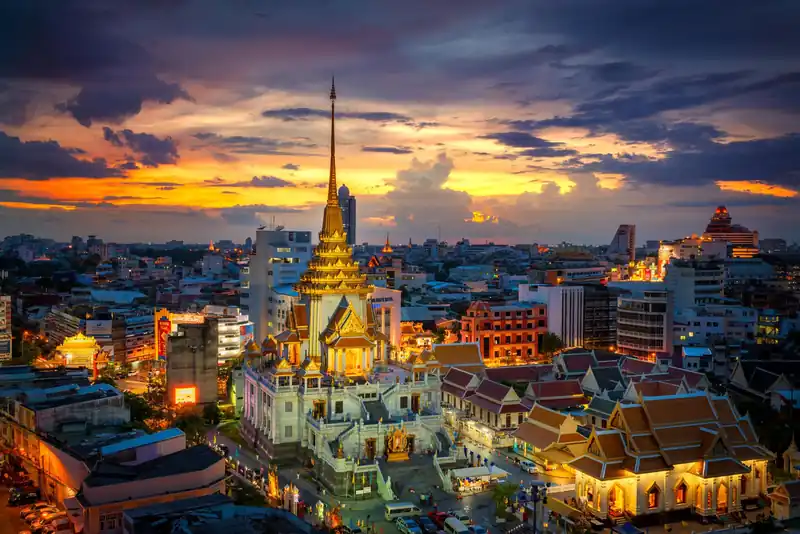
Wat Traimit (Temple of the Golden Buddha)
A Five-and-a-Half-Ton Gold Buddha That Hid Inside Plaster for Two Centuries -- Wat Traimit's main attraction is a seated Buddha image cast from roughly 5.5 tons of solid gold, but for most of its known history the statue was coated in a thick shell of stucco and colored glass, giving it the appearance of an unremarkable plaster image. Historians believe the disguise was deliberately applied, likely to protect the gold from looting during the Burmese sack of Ayutthaya in the 18th century, and it worked so well that the statue's true nature was forgotten for generations. The secret came out by accident in 1955, when workers moving the statue to a new building dropped it from a crane; the plaster cracked on impact, and gold gleamed through the fracture. It remains the largest solid-gold Buddha statue in the world.

Yaowarat Road (Chinatown Bangkok)
A Chinatown Born because the King Wanted the Land for his Palace -- Yaowarat Road is the spine of Bangkok's Chinatown, but the Chinese merchant community settled here not by choice so much as by relocation: when King Rama I founded Bangkok as the new capital in 1782, the Chinese traders who had been living on the chosen palace site were moved downriver to the Sampheng area, which grew into today's Yaowarat district. The street became, and remains, a center of gold trading, with shopfront after shopfront of gold shops reflecting a historical pattern in which Chinese merchant families kept their wealth in gold jewelry, both as a display of status and as a portable store of value that could survive political upheaval. At night the road transforms into one of the densest street-food corridors in the city, built on the same commercial foundation the relocated traders laid more than two centuries ago.
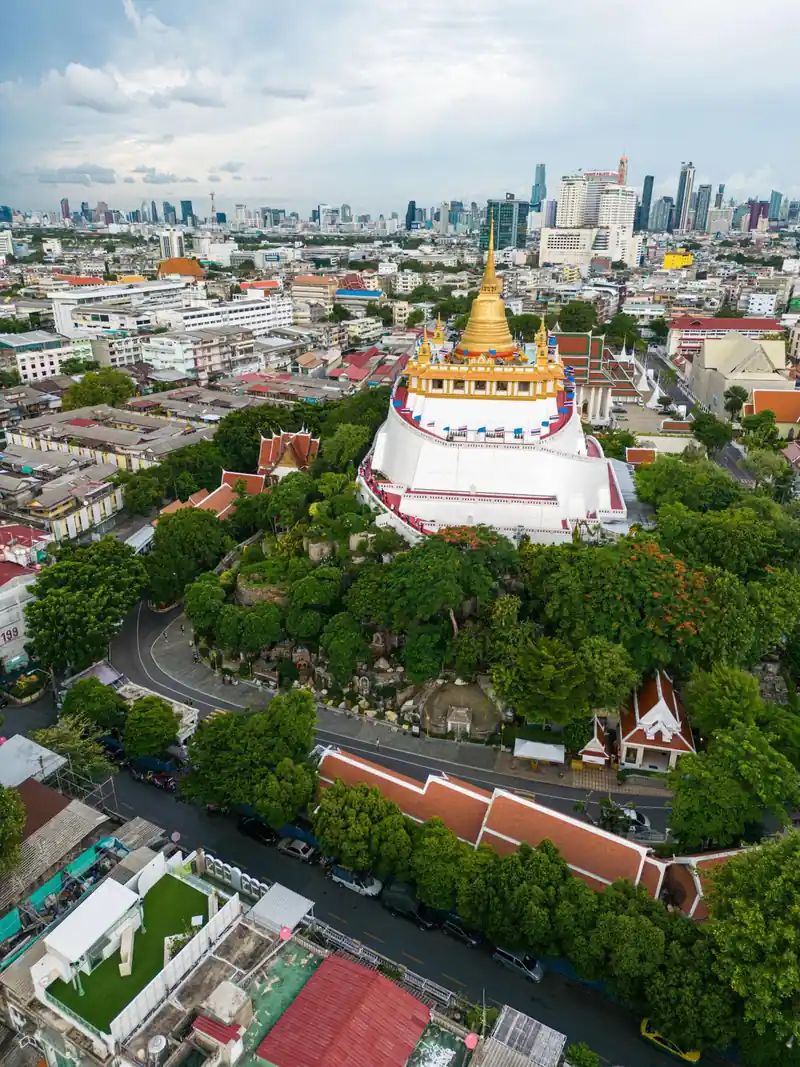
Wat Saket (Golden Mount)
A Golden Mount Born from a Construction Collapse, Rebuilt into a Religious Landmark -- The Golden Mount at Wat Saket is an artificial hill, not a natural one, and its origin traces to a construction failure: King Rama III ordered a large chedi built here in the early 1800s, but the soft Bangkok soil could not support the structure's weight, and it collapsed into a mound of brick and plaster rather than standing as planned. Rather than clear the debris, later builders under Rama IV and Rama V built directly on top of the ruined mound, eventually topping it with a golden chedi that now holds a relic of the Buddha said to have been given by the Indian government. Visitors climb 318 steps spiraling around the hill to reach the summit, which offers one of the few unobstructed panoramic views over Bangkok's older districts.
