Wat Saket (Golden Mount)
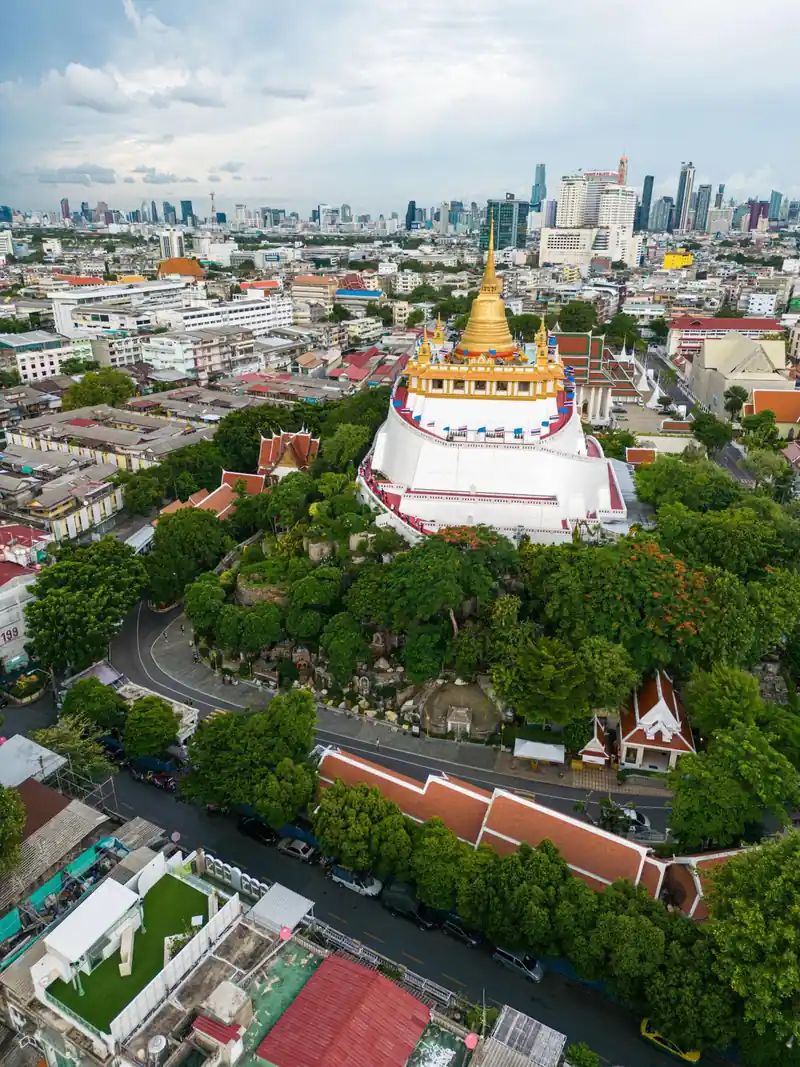
A Golden Mount Born from a Construction Collapse, Rebuilt into a Religious Landmark -- The Golden Mount at Wat Saket is an artificial hill, not a natural one, and its origin traces to a construction failure: King Rama III ordered a large chedi built here in the early 1800s, but the soft Bangkok soil could not support the structure's weight, and it collapsed into a mound of brick and plaster rather than standing as planned. Rather than clear the debris, later builders under Rama IV and Rama V built directly on top of the ruined mound, eventually topping it with a golden chedi that now holds a relic of the Buddha said to have been given by the Indian government. Visitors climb 318 steps spiraling around the hill to reach the summit, which offers one of the few unobstructed panoramic views over Bangkok's older districts.
Visitor Information & Practical Details
- Place NameWat Saket (Golden Mount)
- Address344 Chakkraphatdi Phong Rd, Ban Bat, Pom Prap Sattru Phai, Bangkok 10100, Thailand
- Opening Hours07:30 – 19:00
- Admission / Price50 THB
- Phone+66 2 621 0576
- Official Websitehttps://www.tourismthailand.org/Attraction/wat-saket-ratcha-wora-maha-wihan
- GPS Coordinates13.75284, 100.50660
Best Itinerary Visiting Wat Saket (Golden Mount)
Combine Wat Saket (Golden Mount) with nearby landmarks using our step-by-step walking and transit route.
Places Near Wat Saket (Golden Mount)
Build your own custom walking route in the MyGuide app by combining these nearby stops.
Wat Ratchanatdaram (Loha Prasat – Metal Castle)
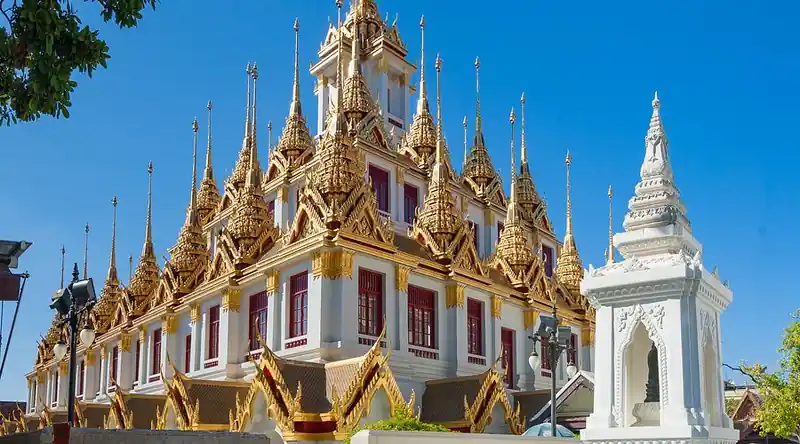
One of Only Three Metal Castles Ever Built, and the Only One Still Standing -- The multi-tiered spire rising from Wat Ratchanatdaram is called the Loha Prasat, or Metal Castle, and belongs to an extremely rare building type: structures built almost entirely of metal rather than stone or brick, of which only three are recorded in history, in Sri Lanka, India, and Thailand, with the Thai example the only one still intact today. Commissioned by King Rama III in the 1840s, the structure rises through several receding tiers topped by 37 metal spires, a number chosen to represent the 37 virtues a Buddhist practitioner cultivates on the path to enlightenment. A narrow internal staircase spirals up through the tiers to a viewing platform near the top, one of the few points in old Bangkok where visitors can climb inside a centuries-old religious monument rather than simply view it from outside.
Wat Suthat Thepwararam
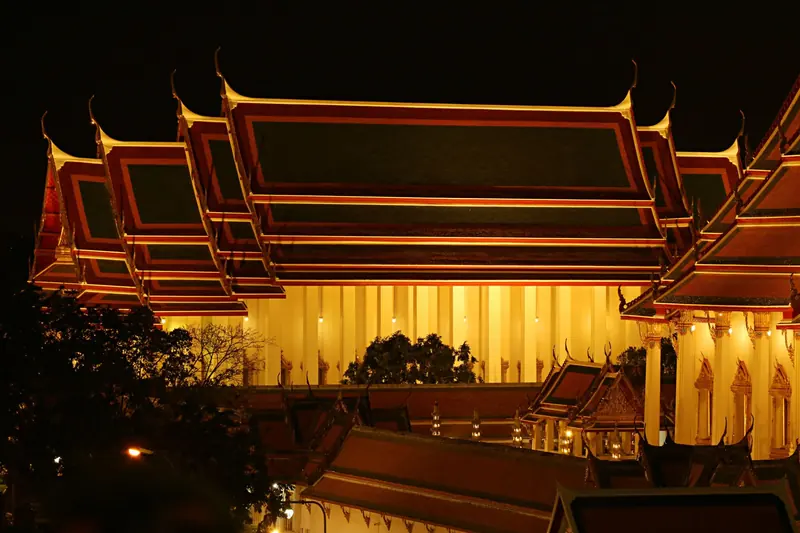
A Towering Swing that was Banned after it Killed Too Many Participants -- In front of Wat Suthat stands the Sao Ching Cha, a pair of tall red teak pillars that once held Thailand's giant ceremonial swing, used in an annual Brahminic ritual called the Triyampawai. In the ceremony, participants swung on a long rope and attempted to grab a bag of silver coins with their teeth from a pole some 15 meters in the air, a feat that produced a steady toll of fatal falls over the years. King Rama VII finally banned the swinging portion of the ceremony in the 1930s after yet another death, leaving the towering red frame standing as a monument to a tradition too dangerous to continue. The temple behind it houses one of Thailand's largest Buddha images and one of its most important collections of Thai mural paintings, overshadowed in most visitors' memories by the empty swing frame out front.
Wat Phra Kaew (Temple of the Emerald Buddha)
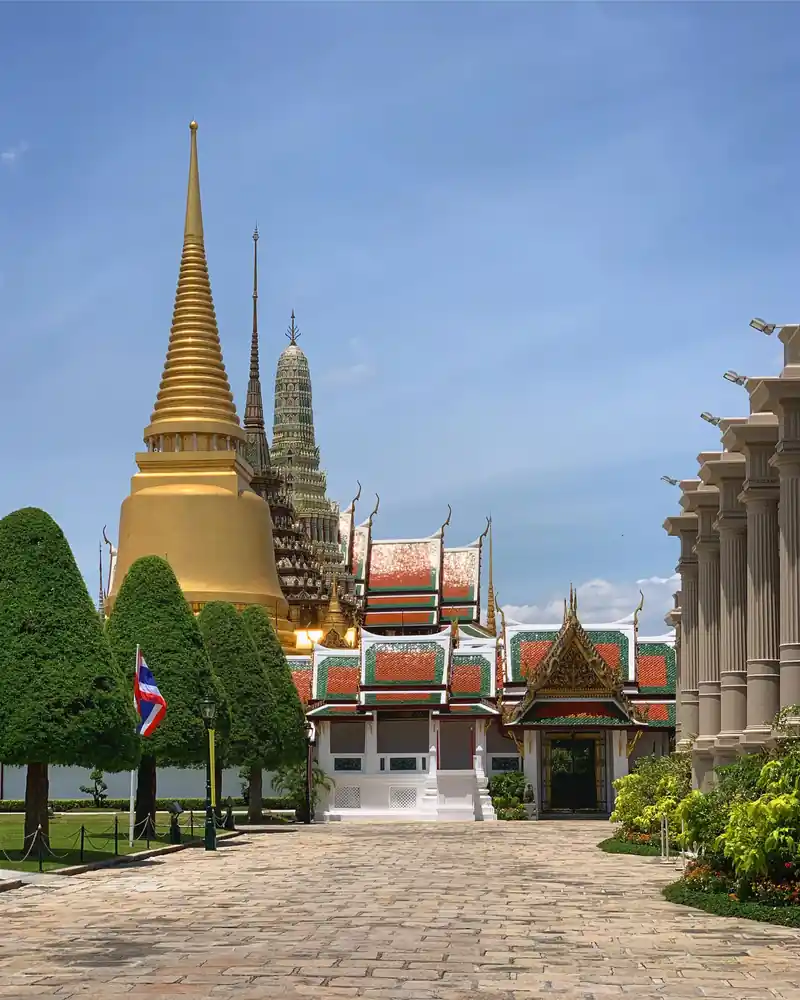
A Jade Statue the King Himself Re-Dresses Three Times a Year -- Despite its name, the Emerald Buddha enshrined at Wat Phra Kaew is carved not from emerald but from a single block of green jasper or jadeite, and its early history is as uncertain as its material: the most repeated legend places its discovery in 1434 in Chiang Rai, when lightning cracked open an unremarkable stucco stupa to reveal the green image hidden inside. The statue then passed through Lampang, Chiang Mai, Laos, and Vientiane over centuries of wars and royal successions before arriving in Bangkok in 1784. Today it sits at the ceremonial center of the Thai monarchy: the king personally presides over a ritual three times a year, at the change of each season, to switch the statue's gold costume between its summer, rainy-season, and winter sets.
Wat Pho
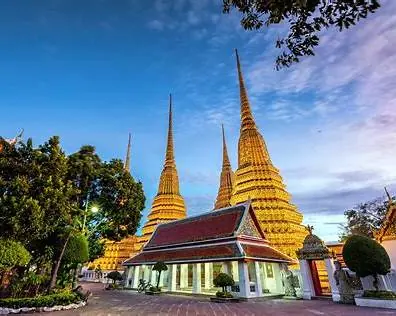
Older Than Bangkok Itself, and the Birthplace of Traditional Thai Massage Education -- Wat Pho existed as a temple on this site before Bangkok became the capital in 1782, making it one of the city's oldest structures, and its grounds hold a reclining Buddha measuring 46 meters long and 15 meters high, so large that visitors walk alongside it rather than viewing it from a distance. Beyond its statuary, the temple functions as Thailand's traditional center for teaching Thai massage, a role formalized under King Rama III, who had medical and massage texts inscribed on stone tablets throughout the complex; UNESCO later recognized this inscribed body of knowledge as part of the Memory of the World. The massage school still operating on the grounds today traces its lineage directly back to that royal-era documentation effort.
Grand Palace
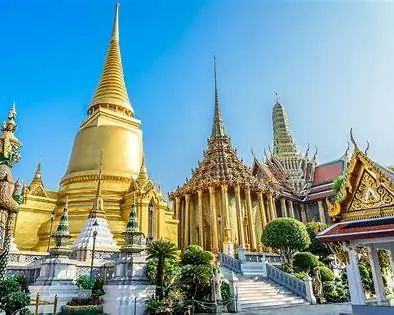
A Palace Built to Announce a New Capital, Mixing Thai Temple Architecture with European Throne Halls -- The Grand Palace complex was built in 1782 when King Rama I moved the Siamese capital across the river from Thonburi to Bangkok, and its grounds still house Wat Phra Kaew, the temple of the Emerald Buddha, the kingdom's most sacred image. While the oldest buildings follow traditional Thai temple design, later 19th-century kings added European-style halls with domed roofs and columned facades, a deliberate blending that signaled Siam's modernization and its engagement with Western powers without ceding its own throne. The complex served as the official royal residence for roughly 150 years, and even though the king no longer lives there, it remains the ceremonial center of the monarchy, hosting coronations and state functions.
Bangkok National Museum
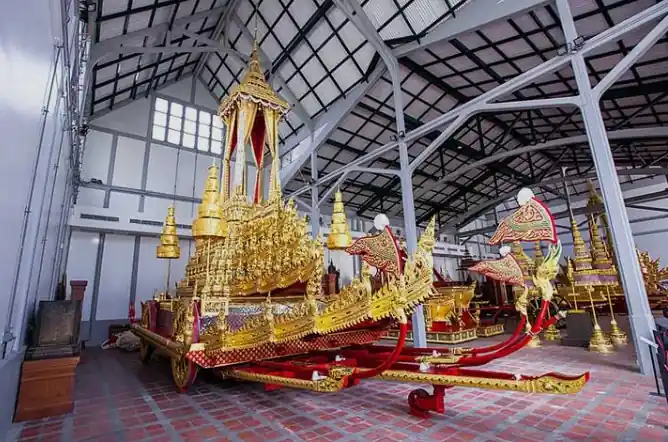
Thailand's Largest Museum, Housed in a Palace Built for a Rival 'Second King' -- The Bangkok National Museum occupies the former Wang Na, or Front Palace, a complex built in the late 18th century to house the Siamese monarchy's 'second king,' a formal deputy ruler position that existed alongside the main king during the early Chakri dynasty before being abolished in 1885. After the position ended, the palace grounds were converted into Thailand's national museum, now the largest in the country, holding collections that range from prehistoric artifacts to Buddhist sculpture. Among its most striking holdings are the royal funeral chariots, elaborately carved and gilded wooden vehicles built to carry the bodies of deceased kings and queens in cremation processions, still brought out of storage and used for state funerals today.
