Moulin Rouge
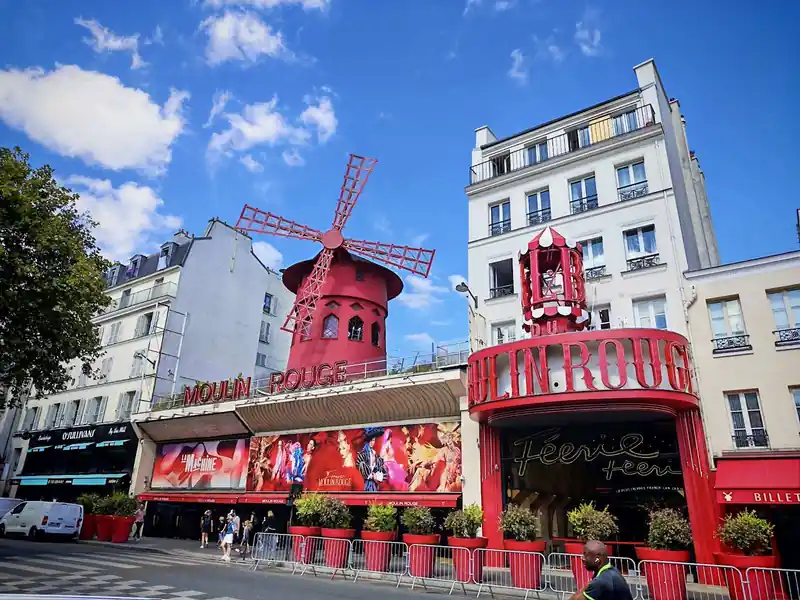
Opened in 1889 at the foot of Montmartre, the same year the Eiffel Tower rose across the city, the Moulin Rouge is the cabaret that essentially invented modern cabaret as a genre, instantly recognizable by the red windmill turning above its entrance on Boulevard de Clichy. It was here that the can-can, previously a somewhat disreputable working-class dance, was reworked into a dazzling, high-kicking stage spectacle that scandalized and thrilled Belle Epoque Paris in equal measure, and here that the painter Henri de Toulouse-Lautrec became a fixture, immortalizing its dancers and atmosphere in posters and paintings that remain some of the most recognizable images of the era. The original building burned down in 1915 and was rebuilt, and while the neighborhood around it in Pigalle has cycled through reputations from bohemian to raunchy to gentrified over the decades, the cabaret itself has continued nightly performances of elaborate feathered revues for well over a century, making it one of the longest continuously operating entertainment venues in the world and, alongside the film that borrowed its name, one of the most internationally recognized symbols of Parisian nightlife.
Visitor Information & Practical Details
- Place NameMoulin Rouge
- Address82 Boulevard de Clichy, 75018 Paris, France
- Opening HoursOpen daily (check locally)
- Admission / PriceFree / Check official site
- PhoneNot listed
- Official Websitehttps://www.moulinrouge.fr
- GPS Coordinates48.88412, 2.33225
Best Itinerary Visiting Moulin Rouge
Combine Moulin Rouge with nearby landmarks using our step-by-step walking and transit route.
Places Near Moulin Rouge
Build your own custom walking route in the MyGuide app by combining these nearby stops.
Montmartre
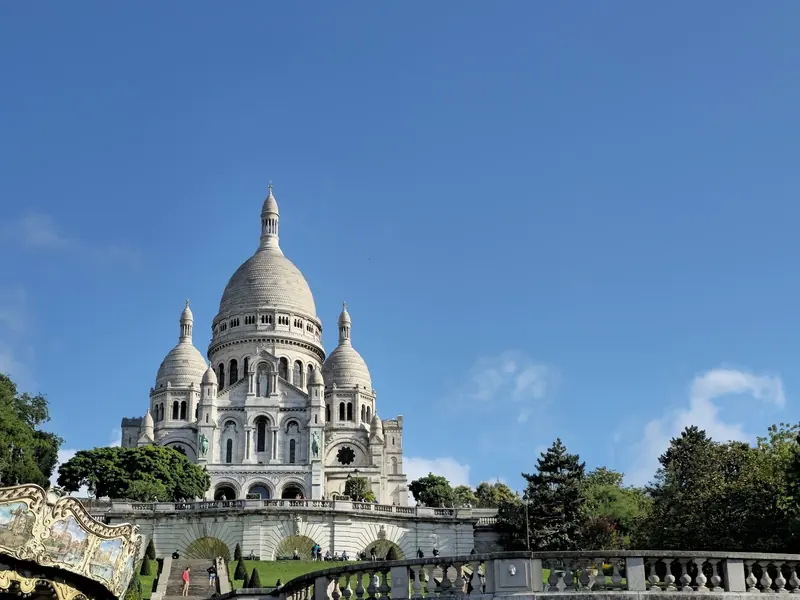
Montmartre is the most famous and beloved of Paris's historic quarters — a hill rising 130 meters above the city in the 18th arrondissement whose distinctive village character, winding cobblestone streets, vineyards, windmills, and the gleaming white domes of the Sacre-Coeur basilica create a landscape unlike anywhere else in Paris, and whose extraordinary history as the bohemian capital of the world from the 1880s through the 1920s established it as the most significant quarter in the history of modern art. Between 1880 and 1940, Montmartre was home to many of the greatest artists of the modern era — Toulouse-Lautrec, who immortalized its cabarets and can-can dancers in his posters for the Moulin Rouge; Van Gogh, who painted its streets and vineyards; Picasso, who created Cubism in the Bateau-Lavoir studio on the Place Emile Goudeau; Modigliani, Utrillo, Braque, and dozens of others whose work defined the trajectory of 20th-century art. The Sacre-Coeur Basilica, built between 1875 and 1914 on the highest point of the hill, is one of the most distinctive buildings in Paris — its Romano-Byzantine domes of gleaming white travertine, designed to be visible from much of the city, and its position commanding views over the entire Paris basin make it both a major pilgrimage site and the defining visual landmark of the Montmartre hill. The Place du Tertre, the central square of the old village, is today crowded with portrait artists and tourist shops but retains enough of its original character to convey the atmosphere of the village within the city that made Montmartre so attractive to generations of painters and writers.
Galeries Lafayette Haussmann
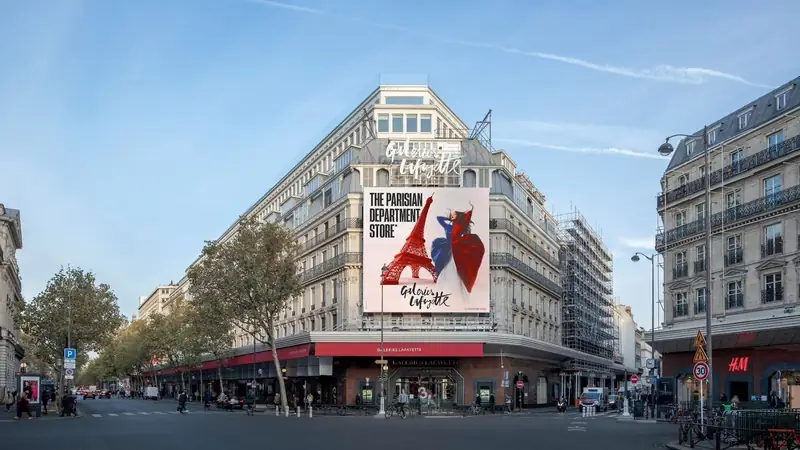
Founded in 1893 as a small haberdashery shop and expanded into its current flagship location beside the Opera Garnier in the early 20th century, Galeries Lafayette Haussmann is one of the most architecturally striking department stores in the world, built around a soaring Belle Epoque atrium topped by a stained-glass dome roughly 43 meters overhead, installed in 1912 in an Art Nouveau style of swirling ironwork and colored glass that remains the store's centerpiece regardless of the fashions sold beneath it. Spread across multiple connected buildings and floors devoted to womenswear, menswear, gourmet food, and luxury brands, the store has functioned since its founding as a showcase for French fashion and craftsmanship as much as a retail destination, and its window displays at Christmas remain a Parisian tradition drawing crowds regardless of whether they intend to shop. A free rooftop terrace, accessible without any purchase required, offers one of the more unexpected panoramic views in central Paris, looking directly across at the gilded dome of the Opera Garnier and out toward the rooftops of the surrounding grand boulevards.
Opera Garnier
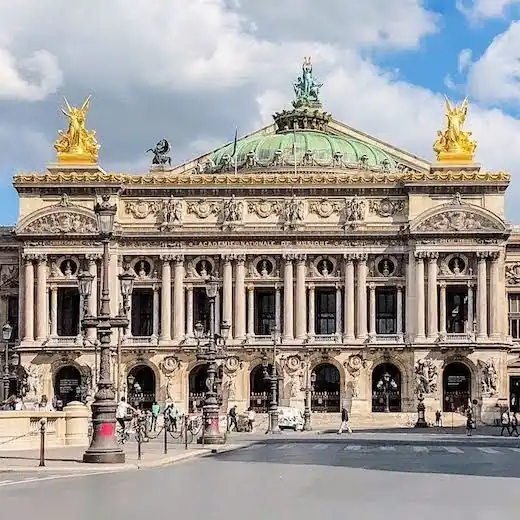
The Opera Garnier (Palais Garnier) is the most opulent theatre building in the world and the supreme achievement of Second Empire architecture — a magnificent palace of the arts built between 1861 and 1875 by the architect Charles Garnier whose Grand Staircase, Grand Foyer, auditorium, and facade represent the highest expression of 19th-century French decorative arts, combining marble, gilded bronze, painted ceilings, crystal chandeliers, and elaborately carved stone in an interior of such concentrated luxury that even in an era of extravagant public buildings it was recognized as something extraordinary. The opera was commissioned by Napoleon III as part of Baron Haussmann's comprehensive rebuilding of Paris, and Garnier won the competition for its design at the age of 35 with a proposal that rejected the severe neoclassicism of his competitors in favor of an eclectic synthesis of styles that Garnier called Napoleon III style — a combination of Baroque exuberance, Renaissance grandeur, and 19th-century theatrical fantasy that proved immediately controversial and enduringly beloved. The Grand Staircase is perhaps the most famous single room in any theatre building in the world — a double staircase rising through a space of marble columns, gilded balustrades, and painted ceilings where the audience itself becomes part of the spectacle as they ascend to their boxes, the whole arrangement conceived by Garnier as a theatre in which the social rituals of the opera-going public would be performed as conspicuously as the performances on stage. The building is perhaps most famous internationally through Gaston Leroux's 1910 novel The Phantom of the Opera, which used its underground lake, labyrinthine backstage passages, and Gothic atmosphere as the setting for one of the most enduringly popular romantic horror stories in literature.
Palais-Royal Garden
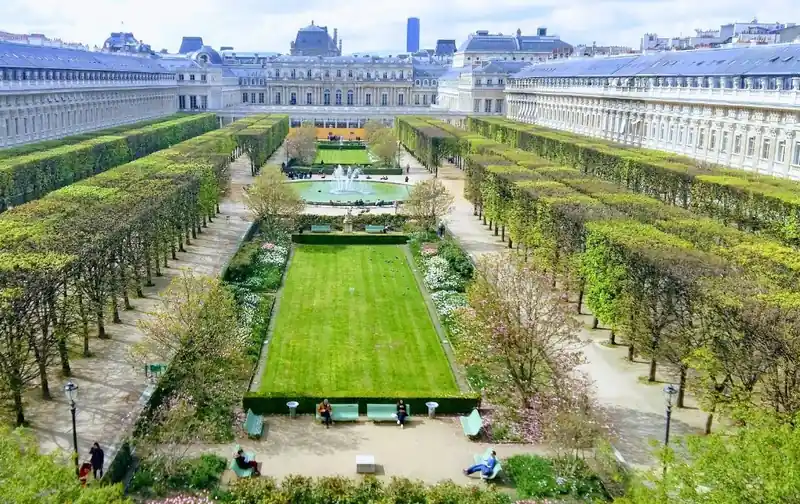
Palais-Royal Garden is a refined and elegant courtyard garden in central Paris, known for its symmetrical layout, peaceful atmosphere, and the iconic black-and-white striped columns of the Colonnes de Buren, offering a quiet and artistic escape just steps away from the busy city streets.
Palais-Royal Garden
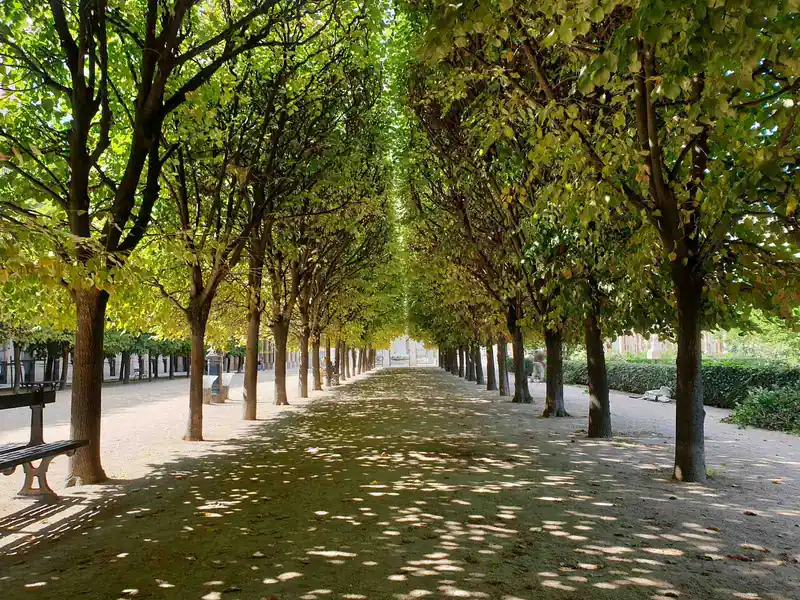
Tucked directly behind the Louvre and laid out in the 17th century for Cardinal Richelieu before passing to the royal family, the Palais-Royal Garden is a rectangular formal garden enclosed on three sides by uniform arcaded galleries that once housed some of Paris's most fashionable shops, gambling dens, and cafes, making the complex a center of Parisian social and political life in the 18th century, including gatherings in its cafes that helped spark the storming of the Bastille in 1789. Today the arcades hold a quieter mix of antique dealers, perfumers, and small boutiques, while the garden itself, lined with clipped lime trees, a central fountain, and rose beds, offers one of the most sheltered and peaceful green spaces in central Paris, largely unknown to visitors who pass right by its unassuming entrances. At the courtyard nearest the Comedie-Francaise, the sculptor Daniel Buren's 1986 installation of black-and-white striped columns of varying heights, known as Les Deux Plateaux, remains a favorite spot for children to climb and photographers to frame, a piece of contemporary public art set against 17th-century stone.
Louvre Museum
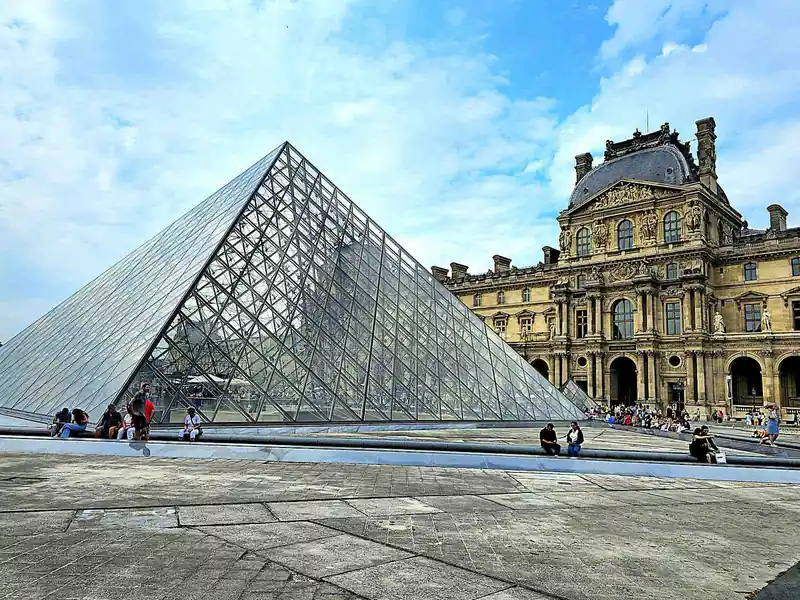
The Louvre Museum in Paris is the largest art museum in the world and one of the greatest cultural institutions in human history — a former royal palace whose vast galleries contain some 380,000 works of art spanning 8,000 years of human civilization, from prehistoric artifacts and ancient Egyptian masterpieces to the greatest paintings of the Renaissance, Baroque, and neoclassical periods, including Leonardo da Vinci's Mona Lisa, the Venus de Milo, and Winged Victory of Samothrace, making it the single most concentrated collection of cultural achievement anywhere on earth. The museum's history spans eight centuries — from its origins as a medieval fortress built by Philip II in the late 12th century, through its transformation into a royal palace under Francis I and subsequent centuries of expansion and embellishment, to its revolutionary-era conversion into a public museum in 1793, making it one of the first great public art museums in the world. The iconic glass pyramid designed by I.M. Pei, added to the main courtyard in 1989, caused controversy when it was built but is now beloved as the principal entrance to the museum and as a symbol of the productive dialogue between ancient history and modern architecture that defines the Louvre's character as an institution. The Mona Lisa, Leonardo da Vinci's small panel painting of an unidentified Florentine noblewoman, is the most visited work of art in the world — a crowd of hundreds gathers around it at any hour of the museum's operation, drawn by a combination of genuine artistic quality, centuries of scholarly attention, and the irresistible pull of its reputation as the most famous painting ever made. With over 9 million visitors annually, the Louvre is the most visited museum in the world.
