Safari World Bangkok
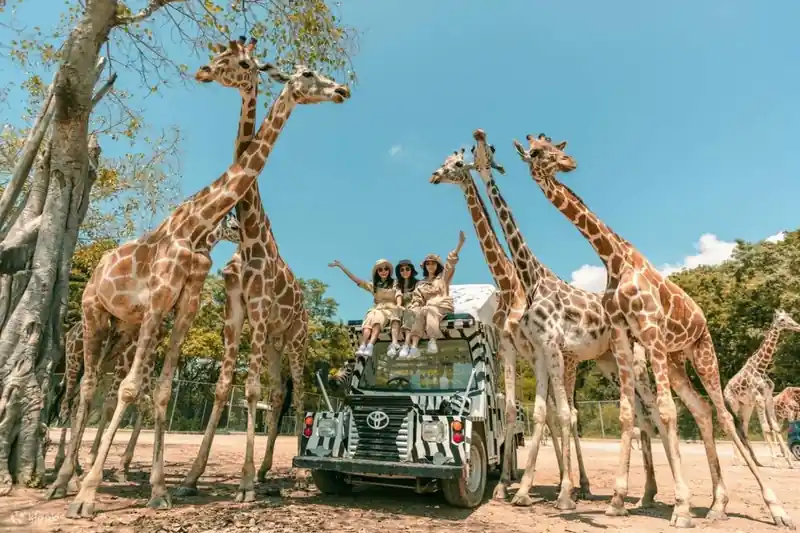
A Park Where Visitors Drive Their Own Car Past Free-Roaming Lions -- Safari World combines a drive-through safari park with a separate marine park on the same grounds, and its signature feature is that visitors can steer their own vehicle along a looped road through enclosures where lions, giraffes, zebras, and other large animals roam without cages or barriers between them and the cars, a format shared by only a handful of parks in Thailand. The marine park section runs separate dolphin and orangutan shows on a conventional stage format. The park has drawn repeated scrutiny from animal welfare organizations over training methods and enclosure conditions for its show animals, controversy that has shadowed its operations even as it remains one of Bangkok's longest-running wildlife attractions, open since 1988 on the eastern edge of the city.
Visitor Information & Practical Details
- Place NameSafari World Bangkok
- Address99 Panyaintra Rd, Sam Wa Tawan Tok, Khlong Sam Wa, Bangkok 10510, Thailand
- Opening Hours09:00 – 17:00 (closing time varies by day and show schedule)
- Admission / PriceVaries by package (Safari Park / Marine Park / combo tickets)
- Phone+66 2 518 1000
- Official Websitehttps://www.tourismthailand.org/Attraction/safari-world
- GPS Coordinates13.86573, 100.70306
Places Near Safari World Bangkok
Build your own custom walking route in the MyGuide app by combining these nearby stops.
Chatuchak Weekend Market (also “JJ Market”)
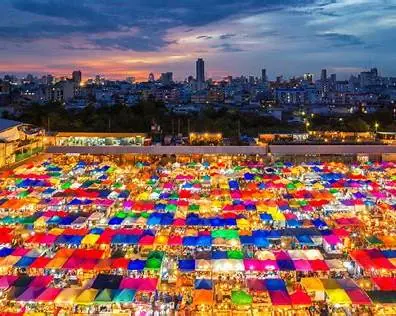
A Market Born from a Government Policy to Consolidate Bangkok's Scattered Vendors -- Chatuchak Weekend Market traces its origin to 1942, when the Thai government under Prime Minister Plaek Phibunsongkhram ordered that every province hold a weekly market, intending to organize the informal vendors scattered across Bangkok's streets rather than let them operate independently. Over the following decades, these consolidated markets gradually moved and merged until settling at the current Chatuchak location in the 1980s, growing into one of the largest weekend markets in the world, with an estimated 15,000 stalls packed into a grid of numbered sections covering everything from antiques to live animals. What began as a bureaucratic effort to bring order to street vending became one of the most disorienting, maze-like shopping experiences in Southeast Asia.
Or Tor Kor Market
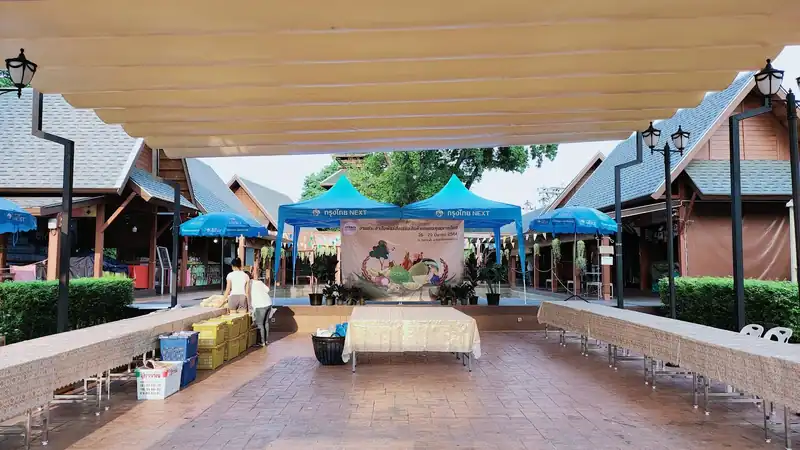
One of the World's Best Food Markets, Overlooked Because It Sits Across the Street From a More Famous One -- Or Tor Kor Market has repeatedly been named among the best fresh food markets on the planet by international food publications, praised for its immaculately clean stalls, pristine seafood displays, and some of the highest-quality Thai produce, ready-to-eat dishes, and tropical fruit available anywhere in Bangkok, favored by professional chefs and serious home cooks over flashier tourist markets. Yet it sits almost literally across the street from Chatuchak Weekend Market, one of the largest and most visited markets in the world, whose sheer scale and reputation pulls the overwhelming majority of tourist foot traffic, leaving Or Tor Kor as the market locals quietly prefer while visitors crowd into its far more chaotic neighbor across the road. The two markets function almost like inverse images of each other within sight of one another, one world-famous and touristy, the other critically acclaimed and comparatively empty of tourists, separated by nothing more than a single street.
Benjakitti Forest Park
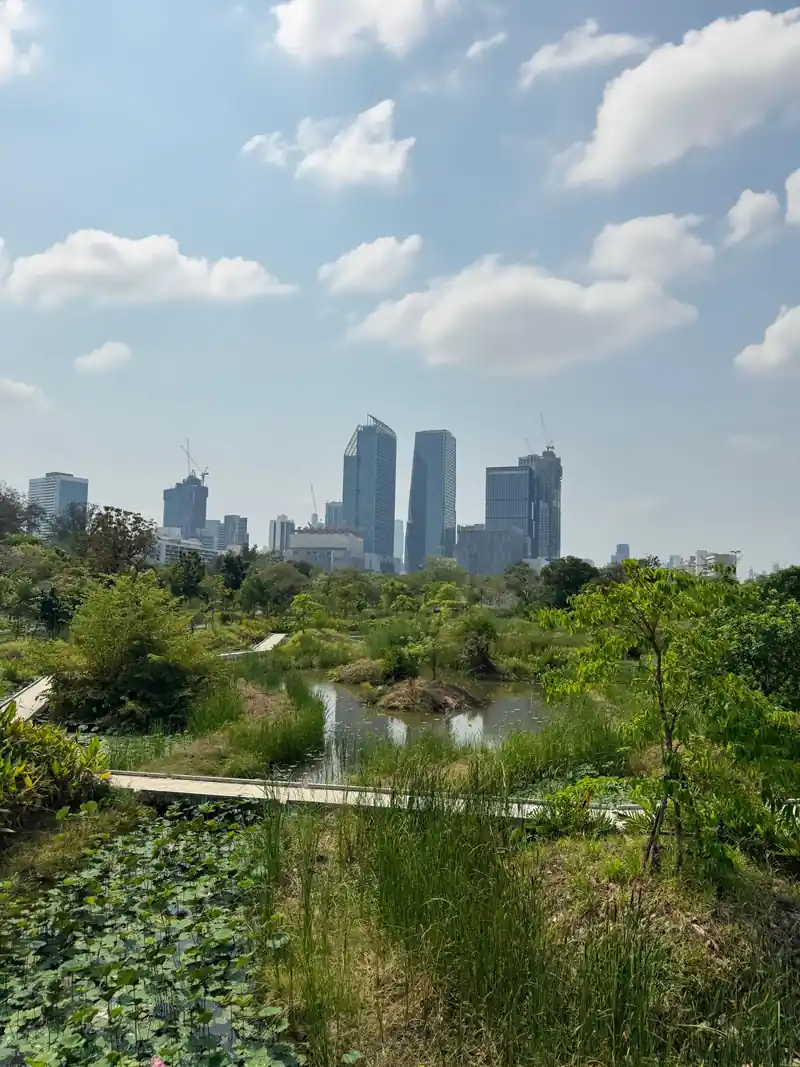
A Park Grown on the Ashes of a State Cigarette Factory -- Benjakitti Forest Park occupies land that once held the Thailand Tobacco Monopoly's cigarette manufacturing complex, a state-run factory that operated in the heart of the city for decades before being relocated and the site repurposed as green space beginning in the 1990s. The park expanded significantly in a major phase completed in 2022, adding a wetland forest section built around reclaimed water-treatment ponds that now host boardwalks winding through planted mangrove and swamp forest species, an unusual piece of constructed wetland ecology for a central business district. It sits directly beside the Queen Sirikit National Convention Center, so the park functions as a green buffer between Bangkok's financial and exhibition district and the elevated Benjakitti Park skywalk that connects to Lumphini Park beyond it, part of a broader effort to stitch together the CBD's fragmented green spaces.
Erawan Shrine
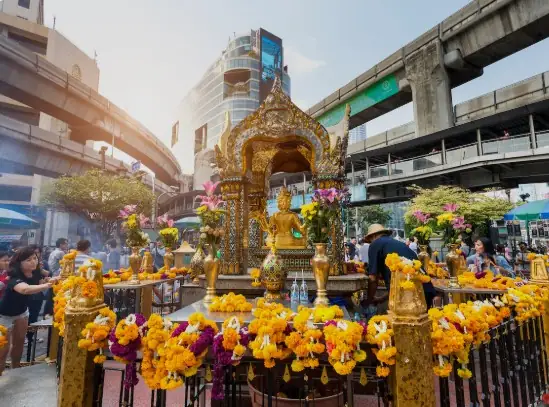
A Shrine Built to Appease Bad Luck, Now Known for Hired Dancers and a 2015 Bombing -- The Erawan Shrine, dedicated to the four-faced Hindu creator god Brahma, known in Thai as Phra Phrom, was erected in 1956 after a string of construction accidents and worker injuries during the building of the adjacent Erawan Hotel; astrologers attributed the mishaps to bad spiritual timing in the hotel's foundation, and the shrine was installed to correct it, after which the construction problems reportedly stopped. The shrine became known for visitors who, upon having a wish granted, hire classical Thai dancers to perform at the site as a form of thanks, a transactional ritual now continuously staged throughout the day. In 2015 a bomb exploded at the shrine, killing more than twenty people in an attack whose motive and perpetrators were never definitively established, after which the shrine was repaired and reopened within weeks.
Asok Skywalk
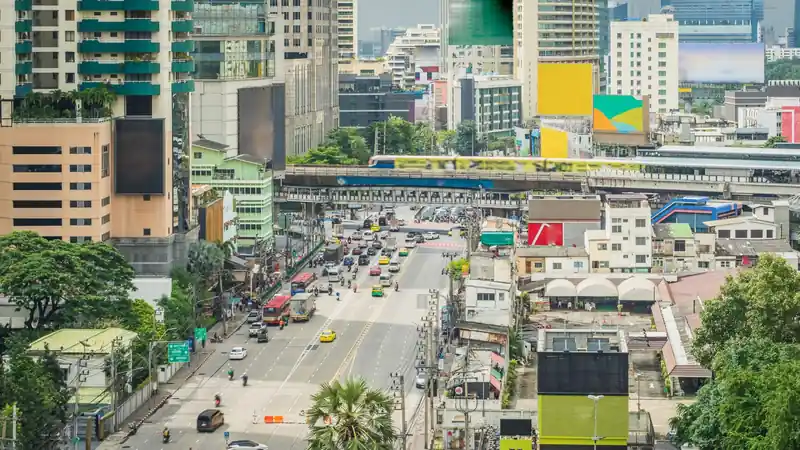
A Walkway Built to Tame Bangkok's Most Congested Intersection -- Asok Skywalk is a segment of Bangkok's growing network of elevated pedestrian walkways, built to connect the Asok BTS Skytrain station directly with the Sukhumvit MRT subway interchange across the street without forcing pedestrians to cross at ground level through one of the city's most notoriously congested intersections. The walkway forms part of a broader strategy, repeated at several other BTS-MRT interchange points across Bangkok, to stitch together the city's elevated rail and underground systems with covered, air-conditioned pedestrian bridges that bypass street-level traffic entirely. For a city built around canals long before cars and still struggling with some of Southeast Asia's worst traffic, these skywalks function as a kind of second, elevated street grid layered above the first, letting commuters move between transit lines, office towers, and shopping centers almost without ever touching the pavement below.
Bangkok Art and Culture Centre (BACC)
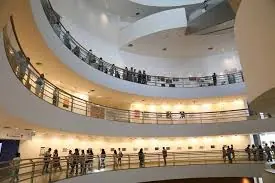
A Museum that Exists Because Activists Fought a Mall for the Land -- The Bangkok Art and Culture Centre occupies a site at the Pathumwan intersection, directly across from Siam Discovery and MBK Center, that for years was earmarked for yet another shopping mall before a sustained public campaign by artists and civic groups pushed the Bangkok Metropolitan Administration to instead build a contemporary art space on the land. The center finally opened in 2008 after roughly a decade of advocacy, delay, and political wrangling over its funding and purpose. Its building wraps nine floors around a central spiral atrium, a layout explicitly designed to reference the ramp of the Guggenheim Museum in New York, and it operates independently of government art institutions, giving it more latitude to show contemporary and sometimes politically pointed Thai work than state-run museums.
