Chateau de Vincennes
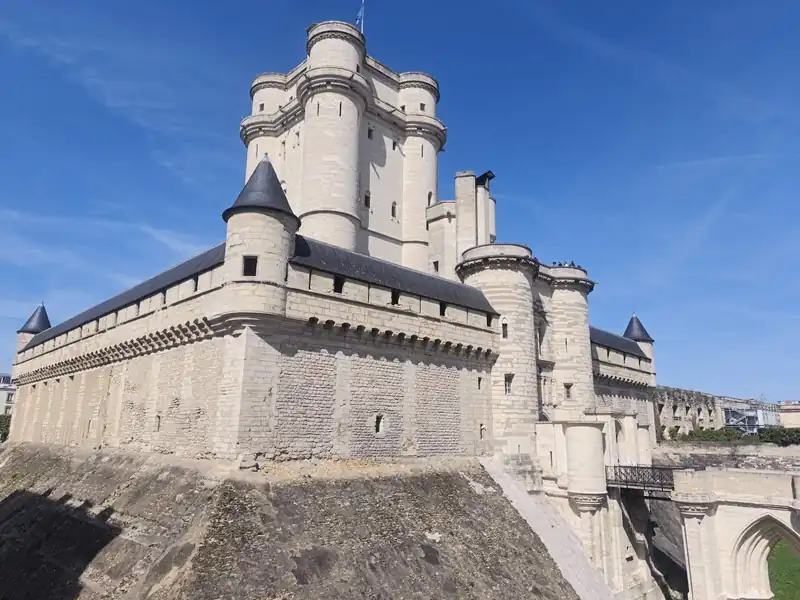
The Chateau de Vincennes on the eastern edge of Paris is one of the finest and best-preserved medieval royal fortresses in France — a massive 14th-century castle whose soaring 52-meter keep is the tallest surviving medieval tower in Europe, and whose moated enclosure, royal chapel, and formidable walls preserve an authentic picture of royal medieval architecture that is all the more remarkable for its location within the modern city of Paris. The castle was built in stages over the 14th century as a royal residence by the Valois kings, and it served as the principal seat of French royal power before Versailles was developed — several kings of France were born, died, or spent significant portions of their reigns at Vincennes, including Henry V of England who died here in 1422 while campaigning in France. The Sainte-Chapelle within the castle enclosure is a Gothic masterpiece begun by King Charles V in 1379 and completed in the early 16th century, whose elaborate sculpted facade and magnificent rose window demonstrate the extraordinary quality of late medieval artistic patronage at the French royal court. The castle later served as a state prison — Diderot was imprisoned here, as was the Marquis de Mirabeau — before becoming an arsenal and military facility in the Napoleonic era, a role it continued until the 20th century when it was finally opened to the public as one of the most important medieval monuments in the Paris region.
Visitor Information & Practical Details
- Place NameChateau de Vincennes
- AddressAvenue de Paris, 94300 Vincennes, France
- Opening HoursDaily 10am-5pm (winter), 10am-6pm (summer)
- Admission / Price11 euros adults
- Phone+33143281547
- Official Websitehttps://www.chateau-de-vincennes.fr
- GPS Coordinates48.84433, 2.43633
Places Near Chateau de Vincennes
Build your own custom walking route in the MyGuide app by combining these nearby stops.
Place des Vosges
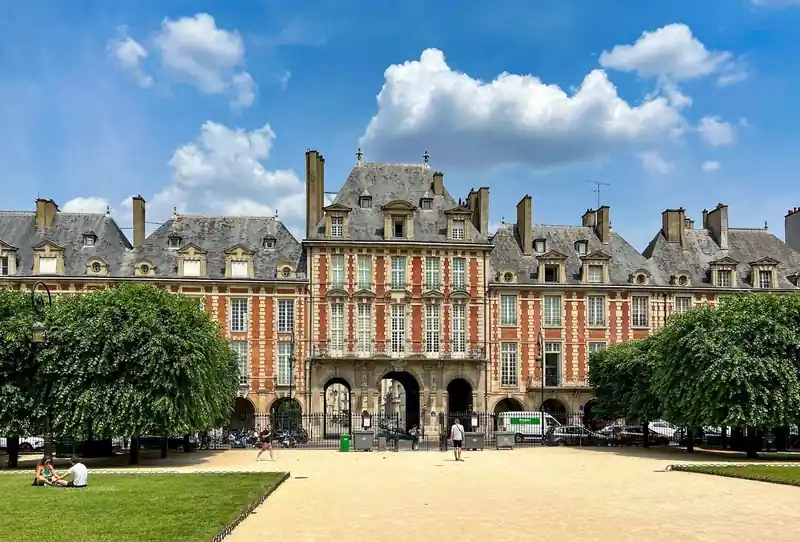
Built by King Henri IV in the early 17th century and completed in 1612, Place des Vosges is the oldest planned square in Paris, a perfect quadrangle of 36 nearly identical townhouses in red brick and pale stone joined by a continuous arcaded gallery at street level. It was originally called Place Royale and served as a fashionable address for nobility, a stage for royal celebrations, and even a dueling ground before it was renamed after the Vosges region during the Revolutionary era as a reward for the first department to pay its taxes in full. Victor Hugo lived at number 6 for sixteen years, and his apartment is now a small museum preserving period rooms and manuscripts. The central garden, with its clipped lime trees, fountains, and gravel paths, remains one of the quietest and most elegant public spaces in the Marais, a favorite spot for Parisians to read, picnic, or simply sit beneath the arcades away from the bustle of the surrounding streets.
Le Marais District
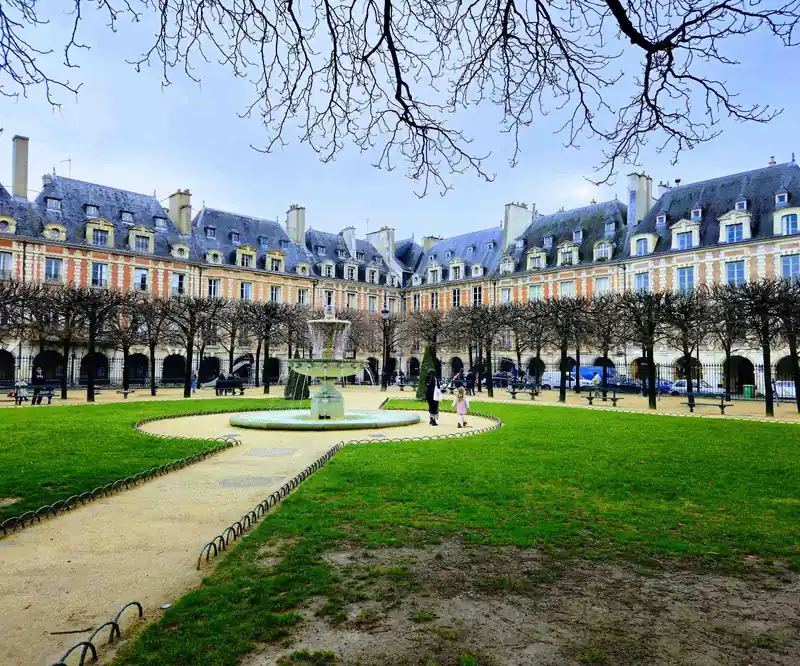
Le Marais is one of the most vibrant and historically layered neighborhoods in Paris — a remarkably well-preserved medieval quarter on the Right Bank of the Seine whose narrow streets and magnificent Renaissance mansions (hotels particuliers) survived the great 19th-century modernization of Paris that demolished most of the medieval city, leaving the Marais as an irreplaceable repository of Paris's pre-Haussmann urban fabric. The district's history spans the full arc of Parisian life — it was the aristocratic heart of Paris during the 16th and 17th centuries, when the nobility built the elegant mansions that still line its streets and gathered around the Place des Vosges, the oldest planned square in Paris, built by Henri IV in 1612 and still one of the most beautiful urban spaces in France. The Jewish Quarter centered on the Rue des Rosiers has been a center of Parisian Jewish life since the 13th century, and despite the devastation of the Holocaust, it retains its character as a living Jewish neighborhood with synagogues, kosher restaurants, and bakeries that make it one of the most authentic Jewish quarters in Western Europe. Today the Marais is also celebrated as one of the most creative and fashionable neighborhoods in Paris — its galleries, concept stores, vintage shops, and cutting-edge restaurants draw visitors from across the city and around the world, while its significant LGBTQ+ community has made it the cultural center of gay Paris for decades. The Marais is home to some of Paris's finest museums including the Musee Carnavalet (the history of Paris), the Musee Picasso, and the Musee de la Chasse et de la Nature, all housed in magnificent historic mansions that are themselves as interesting as the collections within.
Canal Saint-Martin
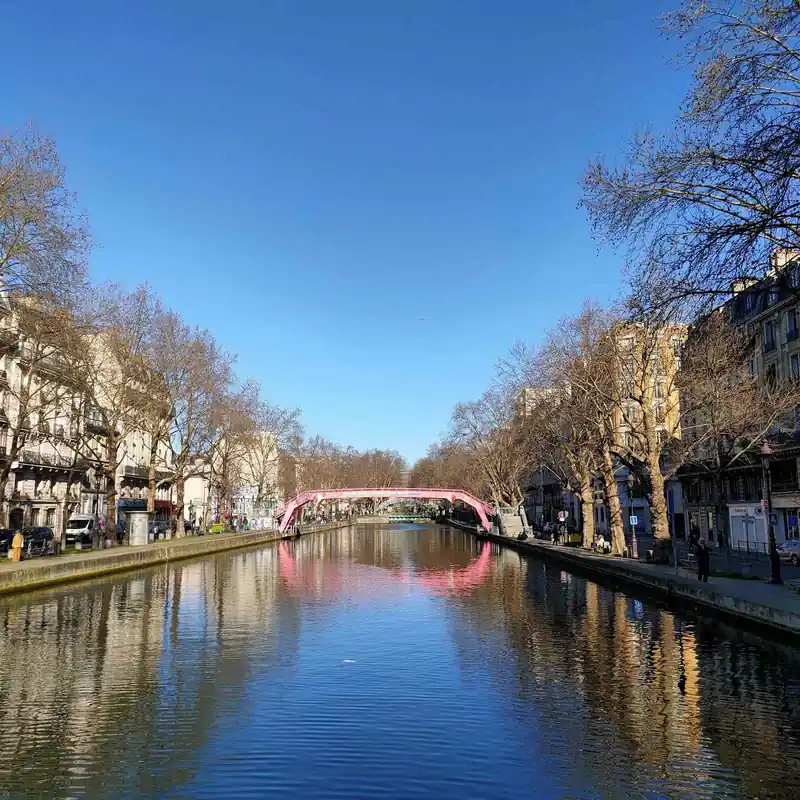
Ordered by Napoleon Bonaparte in 1802 to bring cleaner drinking water into central Paris and to shorten barge traffic on the looping Seine, the Canal Saint-Martin runs for roughly 4.5 kilometers, much of it visible above ground through the 10th and 11th arrondissements before disappearing underground near the Bastille to join the river. Its most distinctive stretch is lined with iron footbridges arching over the water and a series of locks that still raise and lower barges and pleasure boats today, mechanisms that became internationally recognizable after starring in the 2001 film Amelie. Once a working industrial waterway bordered by warehouses, the canal's banks have transformed since the 1990s into one of Paris's most fashionable neighborhoods, its tree-lined quays now filled on warm evenings with young Parisians picnicking on the cobblestones, wine bottles balanced beside them, while the surrounding streets hold an eclectic mix of independent boutiques, record shops, and casual restaurants that give the area a distinctly bohemian, unhurried character rare in the more formal parts of central Paris.
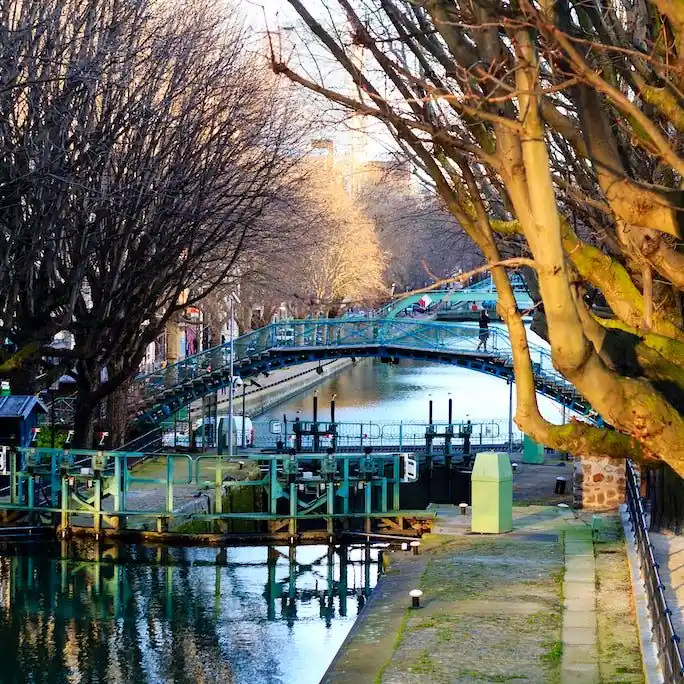
Canal Saint-Martin
Canal Saint-Martin is a trendy and scenic waterway in Paris known for its iron footbridges, tree-lined banks, and relaxed local atmosphere, where visitors can enjoy cafés, picnics, and leisurely walks while experiencing a more authentic and less touristy side of the city.
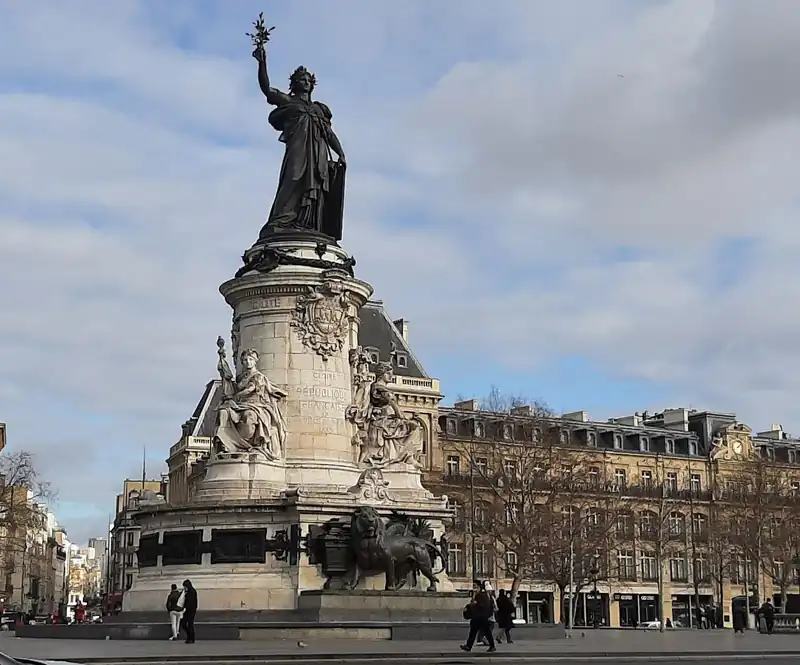
Place de la Republique
Created in the 1850s when Baron Haussmann's renovation of Paris cut wide new boulevards through the city, Place de la Republique is one of the largest squares in Paris, anchored by a towering bronze statue of Marianne, the female personification of the French Republic, holding an olive branch and standing atop a pedestal ringed by allegorical reliefs of Liberty, Equality, and Fraternity and guarded by bronze lions. Unveiled in 1883, the monument replaced an earlier plan for an equestrian statue of Louis XIV and deliberately consolidated the square's identity as a symbol of republican, rather than royal, France. Since the late 20th century the square has become the default staging ground for the country's largest political demonstrations, spontaneous vigils, and national mourning gatherings, its open plaza large enough to hold tens of thousands and its central statue serving as a natural focal point and meeting spot. Beyond its political role, the square today functions as a busy transit hub and pedestrianized public space with a large reflecting pool, informal seating, and easy access on foot to the trendy bars and canal-side cafes of the surrounding 10th and 11th arrondissements.
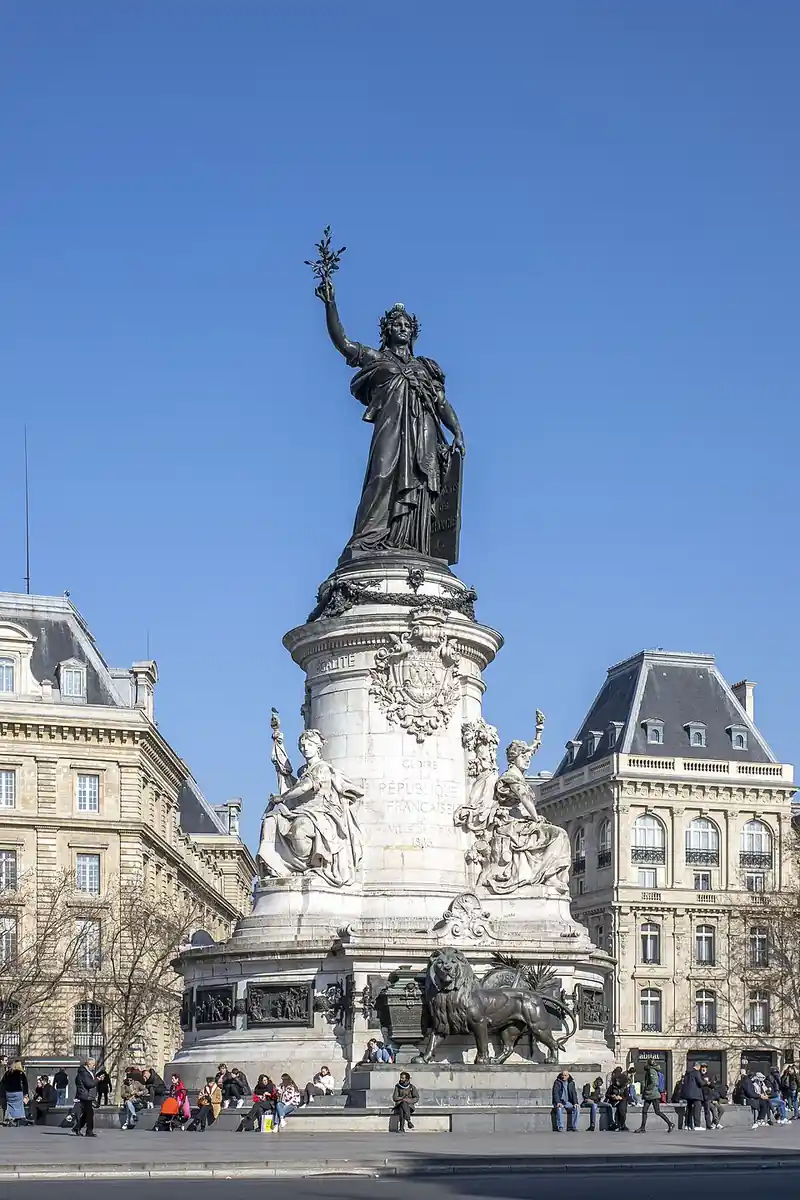
Place de la République
Place de la République is a large and dynamic public square in Paris centered around the Statue of the Republic, known for its open pedestrian space, cultural events, and gatherings, offering a modern urban atmosphere that contrasts with the city’s historic landmarks while still reflecting its social and political life.
